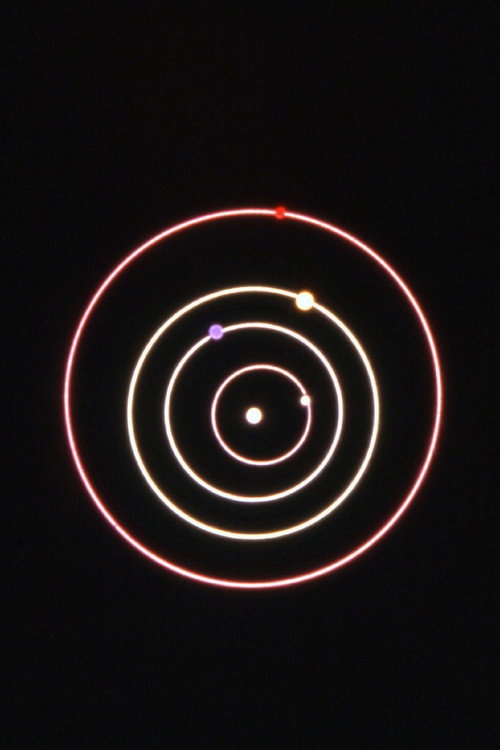
Kepler's Laws 1974
Discover the elegance of celestial mechanics in *Kepler's Laws* (1974), a captivating short documentary directed by the visionary Ray Eames.
Director: Ray Eames
Frequently Asked Questions
What is Kepler's Laws (1974) about?
*Kepler's Laws* (1974) simplifies the groundbreaking work of astronomer Johannes Kepler through animated graphics, illustrating his laws of planetary motion with clear visuals set to Renaissance music.
Who directed Kepler's Laws?
The film was directed by Ray Eames, a pioneering figure in design and animation known for her innovative approach to visual storytelling.
Who stars in Kepler's Laws?
The cast details for this short documentary are not publicly listed.
Is Kepler's Laws (1974) worth watching?
While it's a brief 3-minute experience, *Kepler's Laws* (1974) offers a unique blend of historical education and artistic flair, making it a fascinating watch for astronomy and film enthusiasts alike.
How long is Kepler's Laws?
The runtime of *Kepler's Laws* (1974) is approximately 3 minutes.
About Kepler's Laws (1974) — A Short Documentary on Planetary Motion
Discover the elegance of celestial mechanics in *Kepler's Laws* (1974), a captivating short documentary directed by the visionary Ray Eames. This 3-minute animated masterpiece distills the revolutionary work of 16th-century astronomer Johannes Kepler into vivid graphic symbols, making his groundbreaking laws of planetary motion accessible through mesmerizing visual storytelling. Set against the backdrop of Vincenzo Galilei's delicate 'Little Suite'—performed by the legendary Laurindo Almeida on guitar and lute—the film blends artistry with science, offering a unique fusion of historical insight and musical grace.
Framed within a constant timeframe, the animation transforms abstract astronomical concepts into an immersive experience, inviting viewers to witness the harmony of Kepler's discoveries. With its concise runtime and educational depth, *Kepler's Laws* (1974) serves as a timeless testament to the beauty of discovery, bridging the gap between Renaissance genius and modern cinematic innovation.