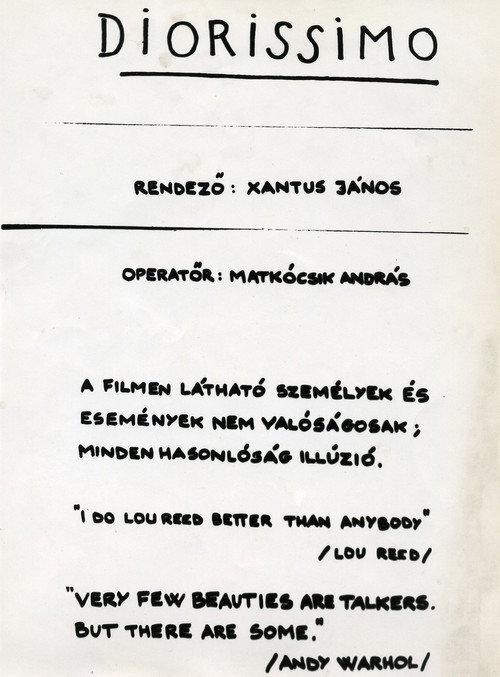
Diorissimo 1980
Diorissimo (1980), a sharp Hungarian comedy directed by János Xantus, explores the darkly ironic consequences of an unintended act of violence.
Director: János Xantus
Cast

Frequently Asked Questions
What is Diorissimo (1980) about?
This short Hungarian comedy follows the accidental fallout of a crime that begins with a single, careless act. As the characters grapple with the consequences, the film blurs the line between comedy and tragedy, leaving audiences to ponder what remains unsaid. Director János Xantus crafts a narrative that feels both intimate and inevitable.
Who directed Diorissimo?
Diorissimo was directed by János Xantus, a Hungarian filmmaker known for his sharp, observational comedies and insightful storytelling.
Who stars in Diorissimo?
The film stars Marietta Méhes, György Kozma, Károly Litványi, Sándor Révész, and others in pivotal roles.
Is Diorissimo (1980) worth watching?
While Diorissimo (1980) is unrated, its blend of dark humor and philosophical undertones makes it a compelling choice for fans of Hungarian cinema and short films. Its 30-minute runtime is tight, but the themes linger long after the credits roll.
How long is Diorissimo?
Diorissimo (1980) is a short film with a runtime of 30 minutes.
About Diorissimo (1980) — A Hungarian Comedy on Unspoken Consequences
Diorissimo (1980), a sharp Hungarian comedy directed by János Xantus, explores the darkly ironic consequences of an unintended act of violence. Clocking in at just 30 minutes, this short film navigates the absurdity and inevitability of a crime that spirals from a moment of carelessness. Drawing inspiration from Wittgenstein's famous dictum about the limits of language, Xantus crafts a narrative that lingers in the space between what is spoken and what remains unsaid. The atmosphere is tense yet understated, balancing humor with a poignant reflection on human fallibility.
With a minimalist yet evocative approach, the film features a compact cast led by Marietta Méhes, György Kozma, and Károly Litványi, whose performances ground the story in quiet realism. The genre's comedic elements serve as a lens to scrutinize moral dilemmas, leaving viewers to question whether justice—or even understanding—can ever truly be achieved in such a scenario. Diorissimo (1980) is a thought-provoking piece that challenges audiences to confront the unspoken tensions beneath everyday interactions.