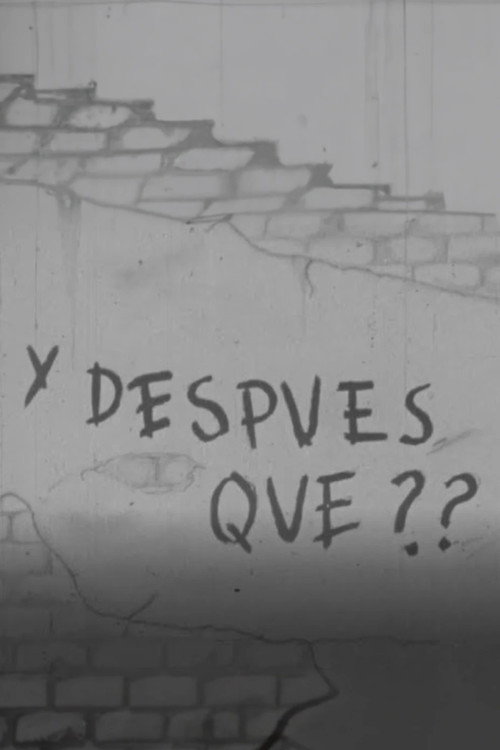
¿Y después qué? 1983
Directed by Victoria Chicón, *¿Y después qué?
Director: Victoria Chicón
Frequently Asked Questions
What is *¿Y después qué? (1983)* about?
This documentary critically examines the two phases of Peru's 1970s military dictatorship, contrasting the policies and downfalls of General Velasco Alvarado and General Morales Bermúdez. Using archival materials, it dissects the political and social climate of the era, highlighting how power shifted—and what remained unresolved.
Who directed *¿Y después qué?*?
The film was directed by Victoria Chicón, a filmmaker known for her incisive documentary work.
Who stars in *¿Y después qué?*?
Cast details for *¿Y después qué?* are not publicly listed.
Is *¿Y después qué? (1983)* worth watching?
While it's a short documentary, *¿Y después qué?* offers a sharp, historically significant look at Peru's military past. Its concise runtime and archival focus make it a compelling watch for fans of political cinema, though casual viewers may find its dense content better suited for those with an interest in 20th-century Latin American history.
How long is *¿Y después qué? (1983)*?
The film runs for 19 minutes.
🎥 Trailer
About ¿Y después qué? (1983) — A Gripping Documentary of Peru's 1970s Military Era
Directed by Victoria Chicón, *¿Y después qué? (1983)* delivers a searing documentary dissection of Peru's turbulent 1970s military era, weaving together archival photographs, radio broadcasts, and news footage to expose the stark contrasts between the regimes of General Velasco Alvarado and General Morales Bermúdez. This 19-minute film doesn't just recount history—it confronts viewers with its raw, unfiltered aftermath, capturing the disillusionment and unresolved tensions of a nation grappling with political upheaval. Shot through with stark visual contrasts and a palpable sense of urgency, Chicón's work transforms fragmented records into a cohesive narrative that lingers long after the credits roll.
As a snapshot of a pivotal decade, *¿Y después qué? (1983)* stands as both a historical artifact and a cautionary tale, blending journalism with cinematic storytelling to probe the lingering consequences of authoritarian rule. Its brisk runtime belies its depth, offering a dense but accessible exploration of power, resistance, and the cyclical nature of governance. For those drawn to politically charged documentaries, this film serves as a potent reminder of how the past echoes into the present.