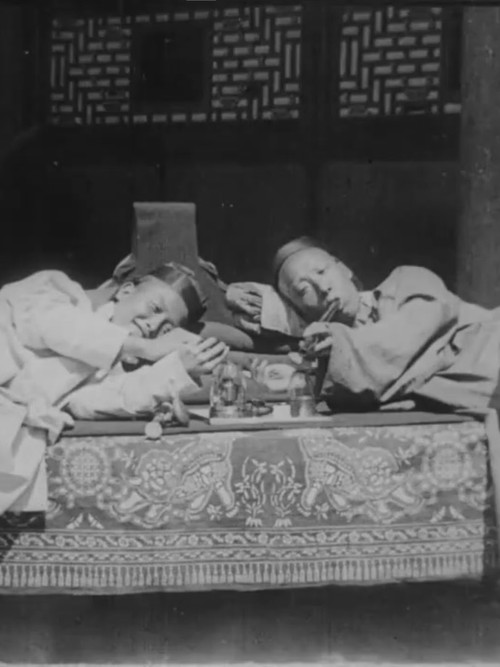
Fumeurs d'opium 1905
One of cinema's most arresting early glimpses into daily life, *Fumeurs d'opium (1905)* captures a fleeting moment frozen in time.
Director: Auguste François
Frequently Asked Questions
What is Fumeurs d'opium (1905) about?
This short documentary from 1905 shows two men engaged in the act of smoking opium in Yunnan, China. The brief scene provides a rare visual record of opium use at the turn of the century, framed as a matter-of-fact ethnographic observation.
Who directed Fumeurs d'opium?
Auguste François directed *Fumeurs d'opium* in 1905. François was a pioneering French filmmaker and explorer whose work often documented life across colonial and remote regions.
Who stars in Fumeurs d'opium?
The film features two unknown participants, whose identities have not been preserved in historical records.
Is Fumeurs d'opium (1905) worth watching?
As a historical document, *Fumeurs d'opium* is more fascinating than entertaining. With no plot, dialogue, or star power, its value lies in its rarity and cultural insight. It's best appreciated by fans of early cinema or those interested in the global history of substance use on film.
How long is Fumeurs d'opium?
The runtime of *Fumeurs d'opium* is approximately 1 minute.
About Fumeurs d'opium (1905) — The earliest film glimpse into opium culture
One of cinema's most arresting early glimpses into daily life, *Fumeurs d'opium (1905)* captures a fleeting moment frozen in time. Directed by Auguste François, this one-minute documentary transports viewers to the misty highlands of Yunnan, China, where two men sit immersed in the quiet ritual of opium smoking. Staged in the austere black-and-white palette of early film, the scene pulses with an eerie stillness that underscores both the exoticism and the haunting isolation of the moment. The film's stark simplicity belies its historical weight, offering a rare ethnographic window into turn-of-the-century Chinese customs and the allure—and dangers—of opium culture.
Wrapped in the early cinema's innocence and curiosity, *Fumeurs d'opium* becomes more than a curiosity; it's a cultural artifact that whispers stories of addiction, colonial encounters, and the slow unraveling of tradition. The atmosphere is thick with smoke and silence, evoking a mood that hovers between fascination and unease. Though modest in length, the film's power lies in its unadorned realism, making it a fascinating entry point for anyone tracing the evolution of documentary filmmaking and the global history of substance use on screen.