
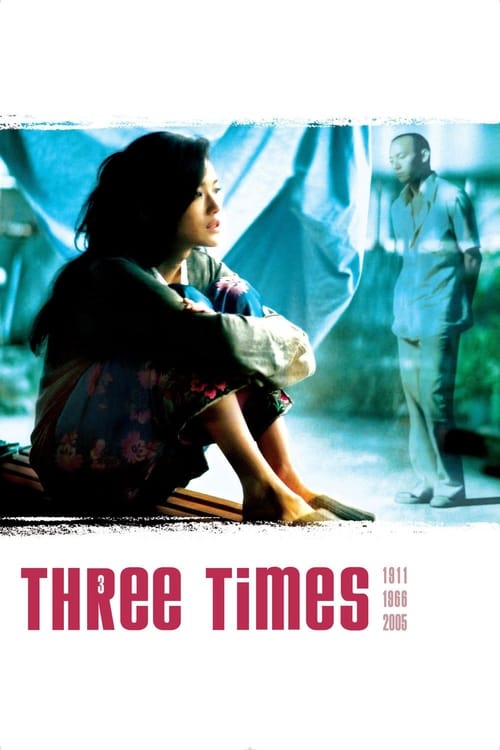
Three Times 2005
Hou Hsiao-hsien's *Three Times (2005)* weaves three distinct yet delicately connected romances across Taiwan's turbulent 20th century.
Director: Hou Hsiao-hsien
Cast

Shu Qi
May / Courtesan / Jing

Chang Chen
Chen / Mr. Chang / Zhen
Su-jen Liao
Hostess / Madam / Jing's Mother
Mei Di
May's Mother / Madam / Aunt
Chen Shi-Zheng
Haruko / Ah Mei / Blue
Lee Pei-Hsuan
Yue / Mickey

Mei Fang
Old Woman

Lawrence Ko Yu-Luen

Wang Chih-cheng
Frequently Asked Questions
What is Three Times (2005) about?
*Three Times (2005)* unfolds three parallel love stories set in different decades of Taiwanese history. Each segment—1911, 1966, and 2005—follows a pair of lovers navigating love, longing, and the social constraints of their time. The film explores how relationships evolve under changing political and cultural landscapes.
Who directed Three Times?
The film was directed by the acclaimed Taiwanese filmmaker Hou Hsiao-hsien, known for his contemplative, visually rich storytelling that often reflects on history and human connections.
Who stars in Three Times?
The cast includes Shu Qi and Chang Chen as the lead couples in each era, with supporting roles by Su-jen Liao, Mei Di, and Chen Shi-Zheng.
Is Three Times (2005) worth watching?
Absolutely, if you appreciate slow-burn, visually stunning dramas that blend romance with historical depth. Hou Hsiao-hsien's direction elevates the material beyond a simple love story, making it a rewarding watch for fans of introspective cinema.
How long is Three Times?
The film runs for 130 minutes, offering ample time to fully immerse yourself in its three intertwined narratives.
🎥 Trailer
About Three Times (2005) — Three Love Stories Across Taiwan's History
Hou Hsiao-hsien's *Three Times (2005)* weaves three distinct yet delicately connected romances across Taiwan's turbulent 20th century. Set in 1911 under Japanese rule, 1966 amid political unrest, and 2005's modern Taipei, each segment explores love's quiet resilience against the backdrop of history. The film's meditative pacing and understated performances by Shu Qi and Chang Chen immerse viewers in an atmosphere where emotions simmer beneath the surface of everyday life. Through its poetic visuals and shifting timelines, *Three Times (2005)* becomes a meditation on connection, memory, and the fleeting nature of human relationships.
The director's signature restraint transforms romance into a canvas for societal reflection, blending nostalgia with subtle tension. Whether through a silent exchange in a teahouse or a fleeting glance in a bustling city, the film captures love's endurance across decades. *Three Times (2005)* isn't just a love story—it's a testament to how history shapes personal moments, and how those moments, in turn, shape who we become.