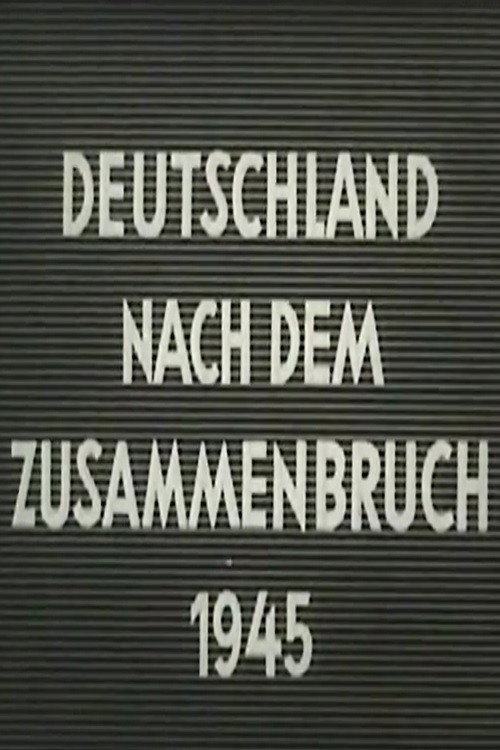
Deutschland nach dem Zusammenbruch 1945 1959
Step back into 1959 with Wolfgang Kiepenheuer's stark black-and-white documentary *Deutschland nach dem Zusammenbruch 1945*, a sobering German gaze on the chaotic months that followed the Third Reich's surrender in May 1945.
Director: Wolfgang Kiepenheuer
Frequently Asked Questions
What is Deutschland nach dem Zusammenbruch 1945 (1959) about?
This 1959 documentary charts the immediate aftermath of Germany's surrender in May 1945, revealing the devastation, refugee crises and tentative political beginnings that defined the first chaotic months of a broken nation.
Who directed Deutschland nach dem Zusammenbruch 1945?
Director information is not available.
Who stars in Deutschland nach dem Zusammenbruch 1945?
Cast details are not listed for this historical documentary.
Is Deutschland nach dem Zusammenbruch 1945 (1959) worth watching?
As a concise, historically grounded snapshot of 1945, the film rewards viewers seeking primary-source context, though its niche appeal and minimal runtime may limit mass interest.
How long is Deutschland nach dem Zusammenbruch 1945?
The film runs approximately 15 minutes.
About Deutschland nach dem Zusammenbruch 1945 (1959) — A 15-Minute Window into Postwar Germany
Step back into 1959 with Wolfgang Kiepenheuer's stark black-and-white documentary *Deutschland nach dem Zusammenbruch 1945*, a sobering German gaze on the chaotic months that followed the Third Reich's surrender in May 1945. Shot for Ikaros-Film with advisory input from historian Dr. Kurt Zentner, the film captures the devastation, uncertainty and fragile rebuilding of a nation emerging from total war. Through archival footage and measured narration, Kiepenheuer sketches a landscape of ruined cities, displaced millions and the first fragile steps toward democracy—all rendered in the film's monochrome palette that underscores both historical distance and haunting immediacy.
Seldom screened yet historically invaluable, the 15-minute documentary is less a polished history lesson than an urgent snapshot of collective trauma. Kiepenheuer avoids sensationalism, instead letting images of rubble-strewn streets, makeshift governments and weary faces speak for themselves. The result is a time-capsule of reflection, offering viewers a raw, first-person glimpse at how Germany began to imagine a future after catastrophe.