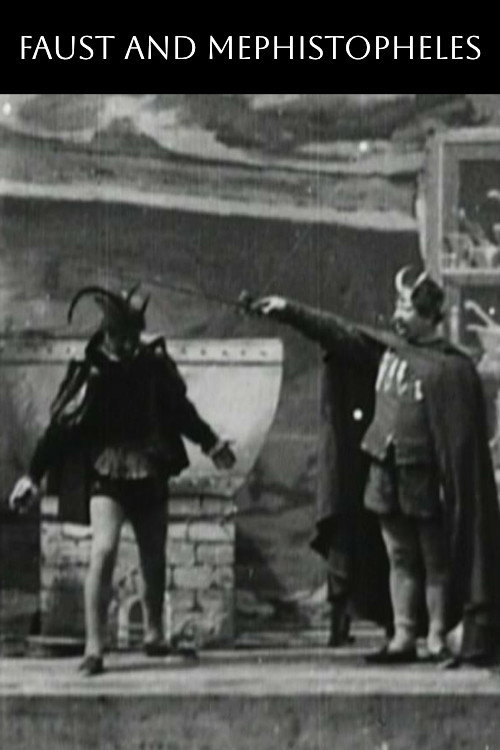
Faust and Mephistopheles 1903
Step into the eerie world of early cinema with Alice Guy-Blaché's brisk yet haunting adaptation of the timeless Faust legend in *Faust and Mephistopheles* (1903).
Director: Alice Guy-Blaché
Frequently Asked Questions
What is Faust and Mephistopheles (1903) about?
This two-minute silent film distills the classic Faust myth into its most essential form, depicting the scholar's fateful encounter with the demon Mephistopheles. In a brief but intense sequence, the film captures the tension of a man trading his soul for knowledge and power.
Who directed Faust and Mephistopheles?
The film was directed by Alice Guy-Blaché, a pioneering French filmmaker and one of the first women to direct a narrative film. Her innovative approach helped shape early cinema.
Who stars in Faust and Mephistopheles?
Director information is not available.
Is Faust and Mephistopheles (1903) worth watching?
While *Faust and Mephistopheles* is more of a cinematic curiosity than a modern thriller, its historical significance and Alice Guy-Blaché's inventive direction make it a fascinating watch for silent film enthusiasts. Its brevity and atmospheric tone offer a unique glimpse into early horror and fantasy.
How long is Faust and Mephistopheles?
The film has a runtime of 2 minutes.
About Faust and Mephistopheles (1903) — Alice Guy-Blaché's Haunting Silent-Era Faust Adaptation
Step into the eerie world of early cinema with Alice Guy-Blaché's brisk yet haunting adaptation of the timeless Faust legend in *Faust and Mephistopheles* (1903). Clocking in at just two minutes, this silent-era gem condenses the centuries-old tale of temptation, ambition, and damnation into a compact yet atmospheric spectacle. Blending elements of fantasy and horror, Guy-Blaché weaves a visually striking narrative that leans on shadowy visuals and dramatic pacing to evoke the timeless struggle between good and evil. The film's brevity belies its ambitious scope, transforming a well-worn myth into a cinematic curiosity that feels both archaic and oddly modern in its execution.
As one of the earliest cinematic interpretations of Faust's pact with the devil, this short film serves as a fascinating artifact for film historians and genre enthusiasts alike. Its concise runtime forces a stripped-down, almost allegorical approach, focusing on the core tension between desire and consequence. The juxtaposition of the fantastical and the macabre creates an unsettling mood, leaving viewers to ponder the moral weight of Faust's choices—all within the span of a single reel. A must-see for fans of early horror and silent cinema, *Faust and Mephistopheles* proves that even in 1903, the allure of the devil's bargain could captivate audiences.