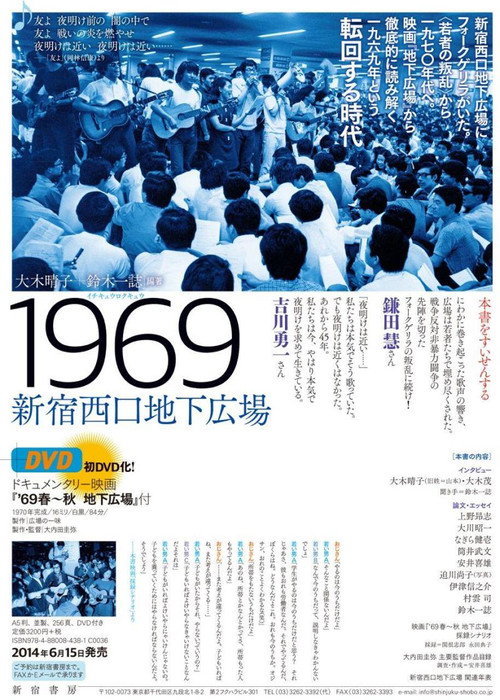
Underground Square 1970
Step back to the charged atmosphere of 1969 Tokyo with *Underground Square (1970)*, Keiya Ouchida's raw documentary that captures a pivotal moment of civic defiance and dialogue.
Director: Keiya Ouchida
Frequently Asked Questions
What is Underground Square (1970) about?
This documentary plunges viewers into the heart of a 1969 student-led occupation beneath Shinjuku Station, where activists declared the concourse a modern 'agora' for political debate. When confrontation erupted with anti-protesters, the uneasy standoff ended with a police-ordered shutdown, capturing a charged moment in Tokyo's history.
Who directed Underground Square?
The documentary was helmed by Keiya Ouchida, a filmmaker known for capturing Japan's social and cultural upheavals of the 1960s.
Who stars in Underground Square?
The film's 'cast' consists of the real-life activists and students who gathered in Shinjuku Station's Underground Square in 1969; no credited actors are listed.
Is Underground Square (1970) worth watching?
Though unrated on IMDb, *Underground Square* offers a compelling slice of political cinema that vividly documents a fleeting but explosive chapter of urban protest. Its 84-minute runtime delivers a punchy, atmospheric dive into dissent, making it essential viewing for fans of 1960s documentary filmmaking and Japanese social history.
How long is Underground Square?
The film runs 84 minutes.
Underground Square (1970): Inside the 1969 Shinjuku Station Protest That Shook Tokyo
Step back to the charged atmosphere of 1969 Tokyo with *Underground Square (1970)*, Keiya Ouchida's raw documentary that captures a pivotal moment of civic defiance and dialogue. In the cavernous concourse beneath Shinjuku Station—dubbed an improvised 'agora'—students and activists turned the transit hub into a living forum for political debate, a bold attempt to reclaim public space in a city divided by protest and reaction. When their experiment in democratic assembly clashed with counter voices and simmering tensions, police moved swiftly to close the square down, crystallizing the era's uneasy balance between free expression and state control. Ouchida's lens frames the clash not as mere history but as a charged microcosm of the decade's ideals and fractures, where every shouted slogan and tense standoff echoes into the neon-lit corridors of modern Tokyo.
More than a time capsule, *Underground Square* offers a visceral snapshot of grassroots democracy in motion. The film's black-and-white palette heightens the contrast between fervor and authority, while its fly-on-the-wall style immerses viewers in the raw energy of a movement that dared to redefine public life. With only 84 minutes, the documentary distills a defining chapter of Japan's late-60s zeitgeist into a gripping, thought-provoking experience—one that lingers long after the final police order.