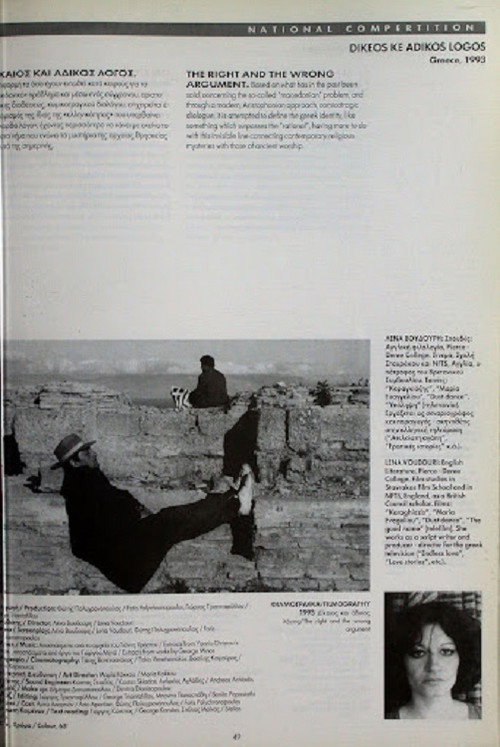
The Right and Wrong Argument 1993
Lena Voudouri's 1993 documentary-style dialogue film *The Right and Wrong Argument* weaves ancient mystery and modern identity into a comic-tragic meditation on what it truly means to be Greek.
Director: Lena Voudouri
Frequently Asked Questions
What is The Right and Wrong Argument (1993) about?
This film explores the concept of "Greekness" through a modern comic-tragic dialogue that revisits the so-called "Macedonian problem." It challenges traditional notions of identity by linking ancient religious mysteries to today's cultural narratives, all while maintaining a sharp, Aristophanic tone.
Who directed The Right and Wrong Argument?
The film was directed by Lena Voudouri, a filmmaker known for blending cultural commentary with theatrical wit.
Who stars in The Right and Wrong Argument?
Cast details are not listed for this film, so prominent performers are not identified.
Is The Right and Wrong Argument (1993) worth watching?
While it doesn't boast a widely known cast or IMDb rating, its philosophical depth and Aristophanic style make it a compelling watch for fans of Greek cinema and cultural documentaries. Its short runtime and thematic ambition offer value for those seeking layered, thought-provoking storytelling.
How long is The Right and Wrong Argument?
The film runs for 65 minutes.
About The Right and Wrong Argument (1993) — A Greek identity debate through comic-tragic lens
Lena Voudouri's 1993 documentary-style dialogue film *The Right and Wrong Argument* weaves ancient mystery and modern identity into a comic-tragic meditation on what it truly means to be Greek. Shot through with Aristophanic wit and layered with philosophical inquiry, the 65-minute runtime unfolds as a razor-sharp inquiry into national self-definition, questioning whether "Greekness" is found in rhetoric alone or in the invisible threads that bind past rites to present realities. The film balances levity and gravity, inviting viewers into a layered conversation that's as culturally specific as it is existentially universal.
Stripping away simplistic labels, Voudouri's work challenges audiences to look beyond surface arguments and connect with deeper, often unspoken cultural continuities. Its dry humor and intellectual daring make it a standout in Greek cinema, offering a rare blend of historical reflection and contemporary relevance that lingers long after the credits roll.