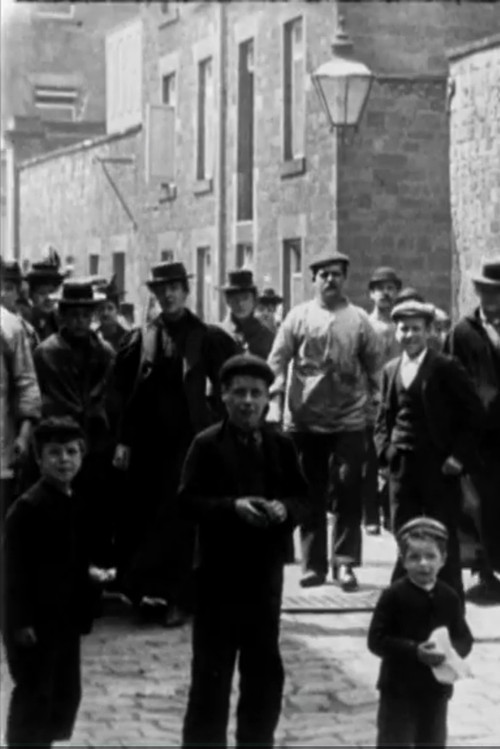
Mill Workers Leaving Oldroyd & Sons Mill, Dewsbury 1900
"Mill Workers Leaving Oldroyd & Sons Mill, Dewsbury"
This fleeting 1900 silent film captures a moment frozen in time: workers of all ages streaming out of Oldroyd & Sons Mill in Dewsbury, their routine exit turning into an unintended spectacle beneath the camera's gaze.
Frequently Asked Questions
What is *Mill Workers Leaving Oldroyd & Sons Mill, Dewsbury* (1900) about?
This historic short film documents workers exiting Oldroyd & Sons Mill in Dewsbury, capturing their reactions to the camera's presence. The one-minute clip offers a rare visual record of late 19th-century industrial labor and social dynamics.
Who directed *Mill Workers Leaving Oldroyd & Sons Mill, Dewsbury*?
Director information is not available for this early silent film.
Who stars in *Mill Workers Leaving Oldroyd & Sons Mill, Dewsbury*?
The cast includes the mill workers themselves, though their identities are unknown. Their spontaneous interactions with the camera form the film's sole 'cast'.
Is *Mill Workers Leaving Oldroyd & Sons Mill, Dewsbury* (1900) worth watching?
While extremely short and lacking plot, this film is a fascinating historical document. Its value lies in its authenticity and the glimpse it offers into early industrial society, making it a must-see for film historians.
How long is *Mill Workers Leaving Oldroyd & Sons Mill, Dewsbury*?
The film runs for approximately 1 minute.
About Mill Workers Leaving Oldroyd & Sons Mill, Dewsbury (1900) — A Curious 60-Second Snapshot of Industrial Life
This fleeting 1900 silent film captures a moment frozen in time: workers of all ages streaming out of Oldroyd & Sons Mill in Dewsbury, their routine exit turning into an unintended spectacle beneath the camera's gaze. Captured in under 60 seconds, the footage transforms an everyday scene into a curious slice of industrial history, where the mill's employees—men, women, and children—become unwitting actors in one of cinema's earliest experiments. The black-and-white frames exude a quiet intensity, offering a glimpse into the rhythms of 19th-century labor life while subtly highlighting the contrast between human dignity and the machinery that employs them.
Witnessing the workers pause, some openly staring at the camera, others hurrying past, the film transforms into a time capsule of social observation. Though stripped of dialogue or narrative, it speaks volumes about the era's working conditions and the curiosity sparked by new technology. A fascinating artifact for historians and film buffs alike, *Mill Workers Leaving Oldroyd & Sons Mill, Dewsbury (1900)* remains a poignant reminder of how ordinary moments can become extraordinary through the lens of the past.