
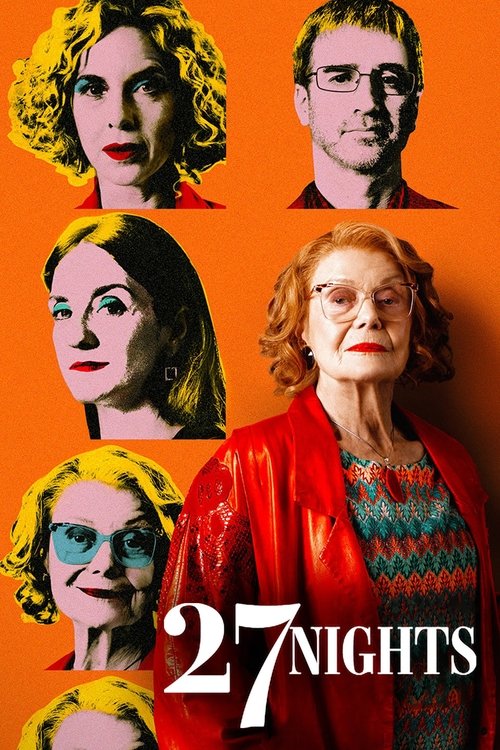
27 Nights 2025
In *27 Nights (2025)*, Uruguayan director Daniel Hendler delivers a sharp, offbeat comedy that explores the thin line between eccentricity and mental health when a free-spirited woman's daughters push for her institutionalization.
Director: Daniel Hendler
Cast

Marilú Marini
Martha Hoffman

Daniel Hendler
Leandro Casares

Humberto Tortonese
Bernardo Girves

Julieta Zylberberg
Alejandra Conde

Paula Grinszpan
Olga Hoffman

Carla Peterson
Myriam Hoffman

Germán de Silva
Julio

Roberto Suárez
Bologna

Alejandra Flechner
Rothman

Mariana Chaud
Gloria Fusco
Frequently Asked Questions
What is *27 Nights* (2025) about?
*27 Nights* follows a vivacious woman whose daughters deem her unbridled lifestyle grounds for psychiatric evaluation. The film dives into themes of autonomy, societal judgment, and whether refusing to play by the rules is a sign of health—or illness.
Who directed *27 Nights*?
*27 Nights* is directed by Daniel Hendler, a Uruguayan filmmaker known for his quirky and insightful storytelling.
Who stars in *27 Nights*?
The film stars Marilú Marini as the spirited protagonist, with Julieta Zylberberg, Carla Peterson, Paula Grinszpan, and director Daniel Hendler rounding out the cast.
Is *27 Nights* (2025) worth watching?
As a comedy with heart and a touch of absurdity, *27 Nights* promises an engaging watch for fans of offbeat cinema. Its blend of humor, social commentary, and strong performances make it a compelling pick for early 2025.
How long is *27 Nights*?
*27 Nights* has a runtime of 108 minutes.
🎥 Trailer
About 27 Nights (2025) — A rebellious woman's joy turns into a psychiatric debate
In *27 Nights (2025)*, Uruguayan director Daniel Hendler delivers a sharp, offbeat comedy that explores the thin line between eccentricity and mental health when a free-spirited woman's daughters push for her institutionalization.
Marilú Marini headlines as the spirited protagonist, a woman whose refusal to conform to societal expectations lands her in the crosshairs of bureaucracy and familial concern. With Hendler at the helm and a talented ensemble including Julieta Zylberberg, Carla Peterson, and Paula Grinszpan, the film blends wit with poignant commentary on individuality, aging, and the absurdities of modern life. Set against a backdrop that balances humor and melancholy, *27 Nights* asks whether joy itself can be mistaken for a condition worth treating.