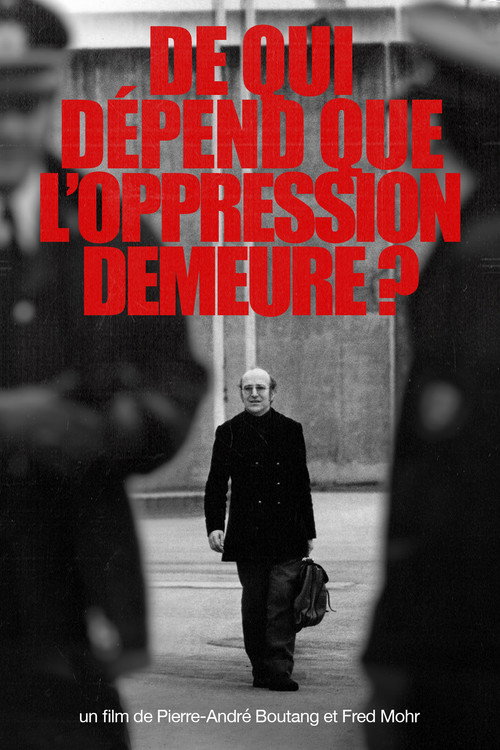
De qui dépend que l’oppression demeure ? 1975
De qui dépend que l'oppression demeure ?
Director: Pierre-André Boutang
Cast


Frequently Asked Questions
What is De qui dépend que l'oppression demeure ? (1975) about?
This documentary examines the 1975 trial of the Red Army Faction's core members, who were accused of terrorism in West Germany. It explores the political tensions, legal controversies, and personal stakes of a landmark case that exposed deep societal divides.
Who directed De qui dépend que l'oppression demeure ??
De qui dépend que l'oppression demeure ? was directed by Pierre-André Boutang, whose work focuses on historical and political themes.
Who stars in De qui dépend que l'oppression demeure ??
The documentary features key members of the Red Army Faction—Andreas Baader, Gudrun Ensslin, Ulrike Meinhof, and Jan-Carl Raspe—alongside lawyer Klaus Croissant and filmmaker Volker Schlöndorff.
Is De qui dépend que l'oppression demeure ? (1975) worth watching?
Though unrated on IMDb, this 40-minute documentary offers a fascinating historical perspective for fans of political cinema. Its exploration of justice, oppression, and radicalism makes it compelling for those interested in 1970s European history, even if it's not a mainstream crowd-pleaser.
How long is De qui dépend que l'oppression demeure ??
The runtime is 40 minutes.
About De qui dépend que l'oppression demeure ? (1975) — A 1970s Trial That Shook Postwar Germany
De qui dépend que l'oppression demeure ? (1975) is a gripping documentary by Pierre-André Boutang that immerses viewers in the charged atmosphere of the 1975 trial of the Red Army Faction members—Andreas Baader, Gudrun Ensslin, Ulrike Meinhof, and Jan-Carl Raspe—who stood accused of orchestrating years of violent attacks in postwar Germany. The film explores the political and legal battlegrounds of the Stuttgart courtroom, where the state's response to radical dissent clashed with the defendants' defiance. Through the lens of Berthold Brecht's evocative question, the documentary dissects the mechanisms of oppression, the erosion of justice, and the human cost of ideological extremism, capturing a pivotal moment in German history.
This 40-minute historical portrait stands out for its unflinching portrayal of a trial that became a symbol of societal fractures in a divided nation. With key figures like lawyer Klaus Croissant playing a central role, the film delves into the controversial conditions of detention and the courtroom's power dynamics. Boutang's direction weaves together archival footage and critical analysis, creating a tense, thought-provoking experience that lingers long after the screen fades.