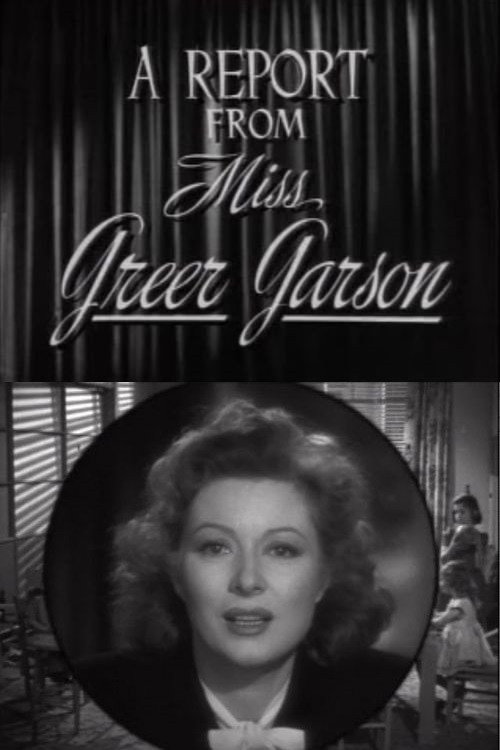
A Report from Miss Greer Garson 1944
Step back to 1944 with *A Report from Miss Greer Garson*, a short but powerful public-health documentary that puts Hollywood glamour in the service of science.
Frequently Asked Questions
What is *A Report from Miss Greer Garson* (1944) about?
This 3-minute short explores infantile paralysis—likely polio—through the eyes of children at various stages of illness and recovery. Hosted by actress Greer Garson, it contrasts hospital wards with cheerful playrooms, highlighting round-the-clock medical care and therapeutic play.
Who directed *A Report from Miss Greer Garson*?
Director information is not available.
Who stars in *A Report from Miss Greer Garson*?
The film is hosted by Greer Garson, with medical staff and young patients featured throughout.
Is *A Report from Miss Greer Garson* (1944) worth watching?
While unrated, its historical and educational value makes it intriguing for classic-film and public-health enthusiasts. The concise runtime and earnest tone offer a poignant glimpse into mid-century medical care.
How long is *A Report from Miss Greer Garson*?
The runtime is 3 minutes.
About A Report from Miss Greer Garson (1944) — A 1944 Public-Health Documentary Hosted by Greer Garson
Step back to 1944 with *A Report from Miss Greer Garson*, a short but powerful public-health documentary that puts Hollywood glamour in the service of science. Fronted by the poised and compassionate Greer Garson, the film turns a clinical lens on infantile paralysis—most likely polio—through a series of intimate, era-specific vignettes. We follow children at every stage of the disease: some confined to beds, others learning to walk again in bright, therapeutic playrooms stocked with period toys and games. Doctors, nurses, and physical therapists work round the clock, blending care with encouragement to help young patients rebuild strength and hope. The atmosphere is one of quiet determination, where medical progress meets childhood resilience under the watchful eye of a wartime America eager for good news.
Shot in crisp black-and-white, the production captures both the stark realities of illness and the gentle optimism of recovery, all hosted by a star whose voice alone conveys trust. It's a fascinating time capsule—part medical manual, part morale booster—showing how entertainment, education, and empathy came together to address a public-health crisis. Whether you're studying classic film or public-health history, the short packs an unexpected emotional punch.