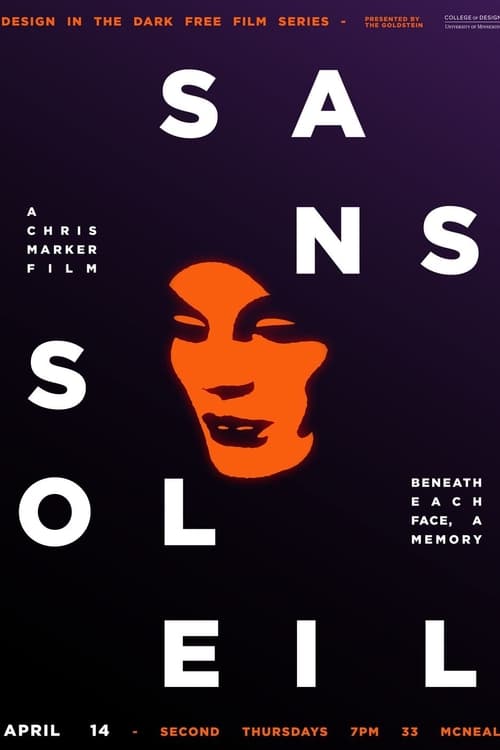
Sans Soleil 1983
"He wrote me..."
Sans Soleil (1983), a hypnotic documentary by visionary French filmmaker Chris Marker, unfolds as a poetic travelogue through time and memory.
Director: Chris Marker
Cast





Frequently Asked Questions
What is Sans Soleil (1983) about?
Sans Soleil (1983) explores the intersection of travel, memory, and time through a narrator's reflections on fragments from Japan, Guinea-Bissau, Iceland, and San Francisco. It's a non-linear meditation on how places shape our perceptions and how we, in turn, shape the stories we tell about them.
Who directed Sans Soleil?
Sans Soleil was directed by the enigmatic French filmmaker Chris Marker, known for his experimental and philosophical approach to cinema.
Who stars in Sans Soleil?
The film features Florence Delay, Arielle Dombasle, and Director Chris Marker himself, with additional appearances by figures like Amílcar Cabral and Bin Akao.
Is Sans Soleil (1983) worth watching?
Sans Soleil (1983) is a cult favorite among art-house and documentary enthusiasts, offering a unique blend of visual poetry and intellectual depth. While not a mainstream pick, its meditative style rewards patient viewers with layers of meaning and stunning imagery.
How long is Sans Soleil?
Sans Soleil has a runtime of 100 minutes.
🎥 Trailer
Sans Soleil (1983): A Poetic Travelogue of Time and Memory — Full Movie Info
Sans Soleil (1983), a hypnotic documentary by visionary French filmmaker Chris Marker, unfolds as a poetic travelogue through time and memory. A woman's voice narrates the musings of a globe-trotting thinker, weaving together fleeting images and reflections from distant lands—Japan's neon-lit streets, Guinea-Bissau's sunbaked landscapes, Iceland's stark horizons, and San Francisco's foggy alleys. Marker's film is less a traditional documentary and more a meditative collage, where each frame feels like a fragment of a dream. The atmosphere is contemplative, blending cultural observation with existential inquiry, making it a hauntingly beautiful experience for fans of art-house cinema.
The film's nonlinear structure and philosophical undertones invite viewers to ponder the nature of time, the fragility of human memory, and the way places imprint themselves on our consciousness. Sans Soleil (1983) doesn't just document; it transforms ordinary moments into something profound, leaving audiences to question how we remember—and why some images linger long after they're seen.