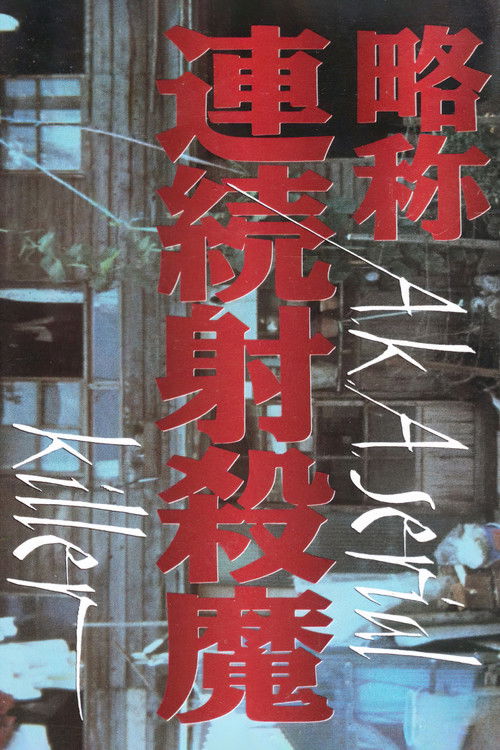
A.K.A. Serial Killer 1975
Dive into the raw, unflinching world of 1970s Japan with *A.K.A. Serial Killer (1975)*, Masao Adachi's gripping documentary that fuses crime and social commentary.
Director: Masao Adachi
Cast

Frequently Asked Questions
What is A.K.A. Serial Killer (1975) about?
This groundbreaking documentary examines the intersection of crime and society in 1960s Japan through the lens of Norio Nagayama, a young man convicted of serial killings. Instead of glorifying his crimes, the film situates Nagayama's actions within the broader context of political upheaval and media sensationalism that defined the era.
Who directed A.K.A. Serial Killer?
Masao Adachi, a Japanese filmmaker known for his politically charged works, directed *A.K.A. Serial Killer*. The film reflects his signature style of blending documentary realism with sharp social critique.
Who stars in A.K.A. Serial Killer?
The film stars Masao Adachi himself, serving as both director and a key presence in the narrative. Its focus is more thematic than star-driven, emphasizing Adachi's vision and the real-life subject, Norio Nagayama.
Is A.K.A. Serial Killer (1975) worth watching?
If you're drawn to documentaries that challenge conventions and delve into the complexities of crime and society, *A.K.A. Serial Killer* is absolutely worth your time. Its unflinching look at media manipulation and youth alienation offers a sobering reflection that feels just as relevant today as it did in the 1970s.
How long is A.K.A. Serial Killer?
The film runs for 86 minutes, delivering a dense and impactful viewing experience in under an hour and a half.
About A.K.A. Serial Killer (1975) — Masao Adachi's Haunting True-Crime Documentary
Dive into the raw, unflinching world of 1970s Japan with *A.K.A. Serial Killer (1975)*, Masao Adachi's gripping documentary that fuses crime and social commentary. At its core, the film explores the turbulent decade marked by political unrest and media frenzy, centering on Norio Nagayama, a real-life teenager whose shocking crimes became a national obsession. Rather than sensationalize, Adachi crafts a haunting portrait, weaving Nagayama's personal story into the broader fabric of Japan's cultural and political struggles. Shot in stark black-and-white, the film pulses with an atmosphere of unease, forcing viewers to confront the fine line between justice and exploitation. It's more than a true-crime exposé—it's a meditation on how society shapes—and is shaped by—its most infamous figures.
Released during an era when Japan was grappling with rapid modernization and deep societal fractures, *A.K.A. Serial Killer* stands as a bold indictment of how media narratives can distort reality. Adachi, both director and co-writer, challenges audiences to look beyond the headlines, offering a layered investigation into the forces that push a young man toward violence. With its uncompromising gaze and minimalist style, the film remains a provocative artifact of its time, demanding reflection on the intersections of poverty, politics, and perception.