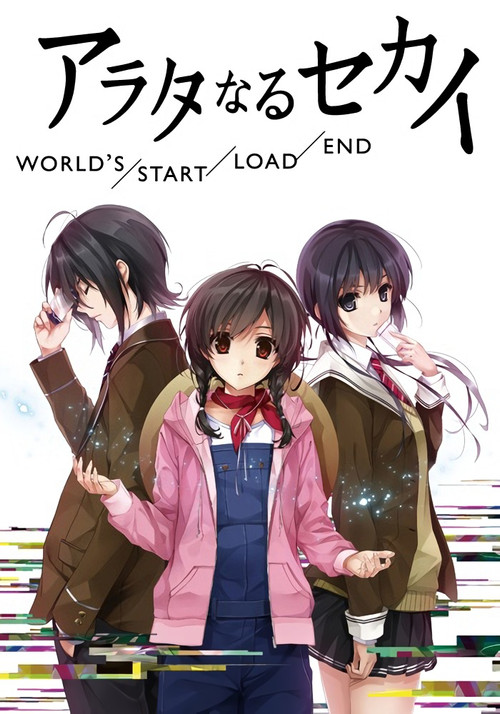
The World of Arata: World's/Start/Load/End 2012
In *The World of Arata: World's/Start/Load/End* (2012), director Yuzuru Tachikawa crafts a hauntingly atmospheric slice of science-fiction animation. The story follows four high school girls clad in uniforms, wandering a desolate, barren landscape—6,000 years into the future.
Director: Yuzuru Tachikawa
Cast







Frequently Asked Questions
What is *The World of Arata: World's/Start/Load/End* (2012) about?
The film follows four teenage girls who are sent 6,000 years into the future to escape a world stuck in a repeating time loop. Disoriented and without a clear mission, they must survive in a barren landscape while grappling with the consequences of time travel.
Who directed *The World of Arata: World's/Start/Load/End*?
The film was directed by Yuzuru Tachikawa, known for his work in animation and his ability to blend science fiction with deep emotional themes.
Who stars in *The World of Arata: World's/Start/Load/End*?
The main cast includes Rumi Okubo, Yuka Iguchi, Yumi Uchiyama, and Risa Taneda as the four time-traveling high school girls.
Is *The World of Arata: World's/Start/Load/End* (2012) worth watching?
With its unique blend of sci-fi and existential themes, *The World of Arata* offers a short but impactful viewing experience. Fans of atmospheric, thought-provoking animation will likely find it compelling despite its limited runtime.
How long is *The World of Arata: World's/Start/Load/End*?
The runtime is 30 minutes.
The World of Arata: World's/Start/Load/End (2012) — A Futuristic Journey Through Time and Silence
In *The World of Arata: World's/Start/Load/End* (2012), director Yuzuru Tachikawa crafts a hauntingly atmospheric slice of science-fiction animation. The story follows four high school girls clad in uniforms, wandering a desolate, barren landscape—6,000 years into the future. These young time travelers were dispatched from a world trapped in an endless loop of the same day to escape human extinction, carrying little more than a simple toy-like cellphone as their only link to the past. With no clear mission, no guidance, and no understanding of their purpose, they must navigate a silent, unforgiving future where survival feels as uncertain as their mission is unclear.
The film blends existential dread with a melancholic beauty, exploring themes of time, purpose, and the fragility of humanity. The stark visuals and muted color palette enhance the sense of isolation and mystery, while the narrative lingers on questions of destiny and the weight of choice. Tachikawa's direction infuses the short runtime with emotional depth, making it a thought-provoking experience for fans of cerebral sci-fi and atmospheric storytelling.