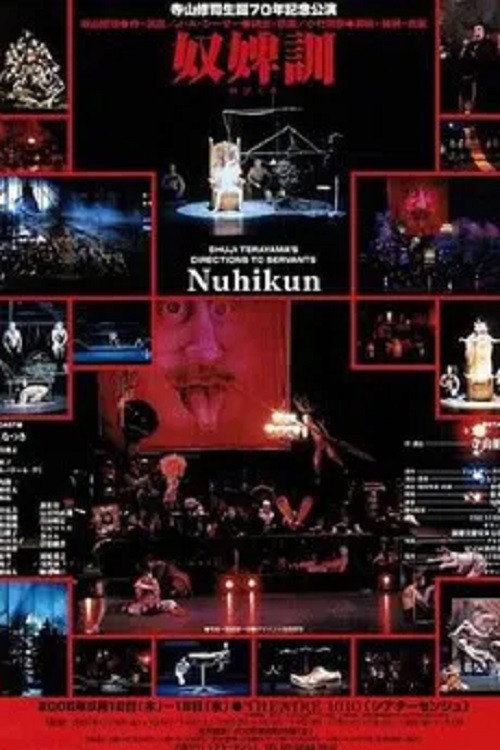
Directions to Servants 1978
Dive into the surreal world of *Directions to Servants* (1978), a bewildering comedy directed by the visionary Shūji Terayama.
Director: Shūji Terayama
Cast


Frequently Asked Questions
What is *Directions to Servants* (1978) about?
The film centers on a man who visits a Japanese estate only to find the servants pretending to be the masters, leaving him to grapple with his own crumbling sense of identity in a world turned upside down.
Who directed *Directions to Servants*?
Shūji Terayama, the acclaimed Japanese filmmaker known for his avant-garde and subversive works.
Who stars in *Directions to Servants*?
The film features Keiko Niitaka, Yoko Ran, Salvador Tari, and Pancho Meguro in key roles.
Is *Directions to Servants* (1978) worth watching?
While not for everyone, fans of offbeat, thought-provoking comedies will appreciate Terayama's audacious take on power dynamics. Its cult status speaks to its unique vision, even if it's not a mainstream crowd-pleaser.
How long is *Directions to Servants*?
The film runs for 106 minutes.
About Directions to Servers (1978) — A surreal comedy that upends hierarchy and identity
Dive into the surreal world of *Directions to Servants* (1978), a bewildering comedy directed by the visionary Shūji Terayama. This avant-garde film follows a man who arrives at a sprawling estate in northern Japan, only to discover the servants and maids have completely inverted their roles—masquerading as the true masters while the rightful owner vanishes. As he wanders through the mansion's lavish yet labyrinthine halls, he's forced to confront the unsettling collapse of his own identity and place in the hierarchy. Terayama's sharp satire blurs the lines between power and illusion, creating an atmosphere that's as playful as it is disorienting.
With a cast led by Keiko Niitaka, Yoko Ran, Salvador Tari, and Pancho Meguro, *Directions to Servants* (1978) challenges audiences to question their own roles in societal structures, all wrapped in Terayama's signature blend of absurdity and social critique. Shot through with dark humor and existential twists, this cult classic feels like stepping into a carnival mirror maze where reality is whatever the staff decides it to be.