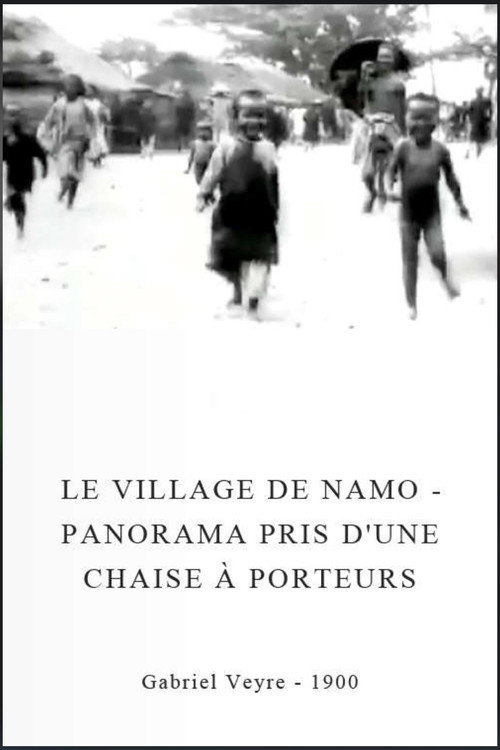
Le village de Namo - Panorama pris d'une chaise à porteurs 1900
Step into the pioneering world of early cinema with *Le village de Namo - Panorama pris d'une chaise à porteurs* (1900), a groundbreaking documentary that offers a fleeting but fascinating glimpse into 19th-century life.
Director: Gabriel Veyre
Frequently Asked Questions
What is *Le village de Namo - Panorama pris d'une chaise à porteurs* (1900) about?
This short documentary transports viewers to a Vietnamese village in 1900, captured through a unique moving-camera technique. The film's brief runtime showcases the Lumière brothers' innovative approach to early cinema, immersing audiences in a slice of daily life from over a century ago.
Who directed *Le village de Namo - Panorama pris d'une chaise à porteurs*?
The film was directed by Gabriel Veyre, a pioneering French filmmaker known for his contributions to early cinema and his work in capturing scenes from around the world during the late 19th and early 20th centuries.
Who stars in *Le village de Namo - Panorama pris d'une chaise à porteurs*?
Cast details for this 1900 documentary are not recorded, as early films of this era often focused on capturing locations and events rather than individual performers.
Is *Le village de Namo - Panorama pris d'une chaise à porteurs* (1900) worth watching?
While the film is extremely short, its historical significance and innovative technique make it a fascinating watch for film enthusiasts and historians. Its raw, unfiltered perspective offers a rare glimpse into early 20th-century Vietnam, providing context for the evolution of documentary filmmaking.
How long is *Le village de Namo - Panorama pris d'une chaise à porteurs*?
The runtime of *Le village de Namo - Panorama pris d'une chaise à porteurs* is just under one minute.
Le village de Namo - Panorama pris d'une chaise à porteurs (1900): Early Cinema's First Glimpse of Vietnam
Step into the pioneering world of early cinema with *Le village de Namo - Panorama pris d'une chaise à porteurs* (1900), a groundbreaking documentary that offers a fleeting but fascinating glimpse into 19th-century life. Directed by the visionary Gabriel Veyre, this one-minute silent film captures a dynamic panorama shot from a moving perspective, a technique that would later become a staple of cinematic storytelling. The film's brief runtime belies its historical significance, as it belongs to the Lumière brothers' innovative experiments with mobile camera work, transporting viewers on a journey through an unnamed Vietnamese village. With its raw, unfiltered aesthetic, the footage transports audiences to a bygone era, evoking curiosity about the people, culture, and landscapes of the time. Though minimalist in length, its cultural and technical impact resonates as a testament to the birth of documentary filmmaking.
Gabriel Veyre's creative approach transforms an ordinary scene into a mesmerizing time capsule. The film's immersive movement—achieved by placing the camera on a chair mounted on a moving platform—creates a sense of motion and discovery, almost as if the viewer is personally strolling through the village. While the exact cast remains unknown, the film's enduring appeal lies in its ability to transcend time, offering modern audiences a rare window into the world of 1900. For historians, film buffs, and anyone intrigued by the origins of cinema, *Le village de Namo - Panorama pris d'une chaise à porteurs* (1900) remains a must-experience piece of early visual storytelling.