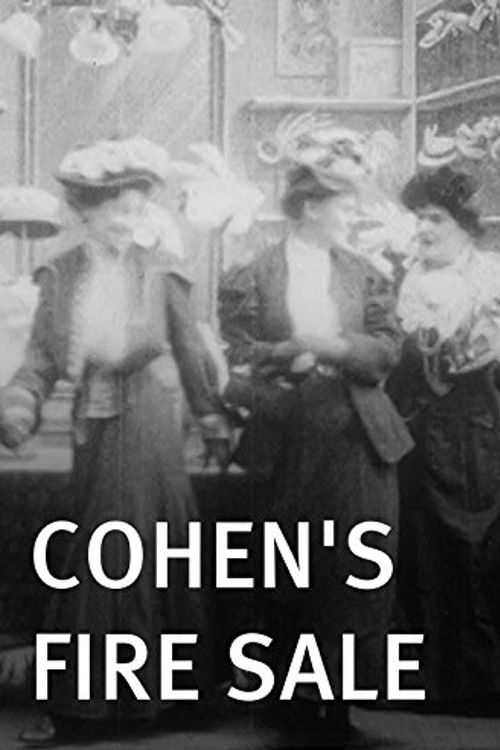
Cohen’s Fire Sale 1907
Cohen's Fire Sale (1907), directed by the pioneering Edwin S. Porter, is a short silent-era comedy that blends humor with a touch of mischief.
Director: Edwin S. Porter
Frequently Asked Questions
What is Cohen's Fire Sale (1907) about?
This short silent comedy follows a shopkeeper whose merchandise disappears, leading him to devise a reckless plan to recover his losses. The film blends humor with a touch of crime, all set against the backdrop of early 20th-century commerce. Expect exaggerated antics and visual gags in this 13-minute relic.
Who directed Cohen's Fire Sale?
Cohen's Fire Sale was directed by Edwin S. Porter, a pioneer of early American cinema known for his innovative storytelling techniques.
Who stars in Cohen's Fire Sale?
The original cast details for Cohen's Fire Sale (1907) are not documented, but the film's charm lies in its visual storytelling rather than specific performers.
Is Cohen's Fire Sale (1907) worth watching?
While Cohen's Fire Sale is more of a historical curiosity than a modern masterpiece, it's a fascinating snapshot of early filmmaking. Fans of silent comedy or vintage cinema will appreciate its humor and simplicity, even if it lacks the polish of later works. As an unrated short, it's best viewed with an open mind and a sense of nostalgia.
How long is Cohen's Fire Sale?
Cohen's Fire Sale (1907) has a runtime of 13 minutes.
🎥 Trailer
About Cohen's Fire Sale (1907) — A Silent-Era Comedy of Mischief and Mayhem
Cohen's Fire Sale (1907), directed by the pioneering Edwin S. Porter, is a short silent-era comedy that blends humor with a touch of mischief. The story follows a shopkeeper whose valuable goods mysteriously vanish, sparking a creative (and ultimately disastrous) scheme to recoup his losses. Set against the bustling backdrop of early 20th-century commerce, the film captures the chaotic energy of small-town life, where desperation meets absurdity in equal measure. With its 13-minute runtime, Porter delivers a tightly paced narrative that balances lighthearted antics with a hint of crime—all wrapped in the charm of silent-era storytelling. The atmosphere is playful yet unpredictable, leaving audiences to wonder just how far the shopkeeper will go to solve his problem.
As one of the earliest examples of American slapstick cinema, Cohen's Fire Sale offers a fascinating glimpse into the evolution of comedic filmmaking. The absence of dialogue is no barrier here; instead, Porter relies on visual gags and exaggerated performances to drive the humor, a hallmark of the era. While the cast remains a mystery, the film's legacy lies in its ability to entertain with minimal resources, proving that great comedy transcends time and technology. For fans of vintage cinema, this short is a delightful relic—a testament to the creativity that flourished long before CGI or modern effects.
Explore Cohen's Fire Sale (1907) for a glimpse into early film history, where simplicity meets innovation and every frame tells a story.