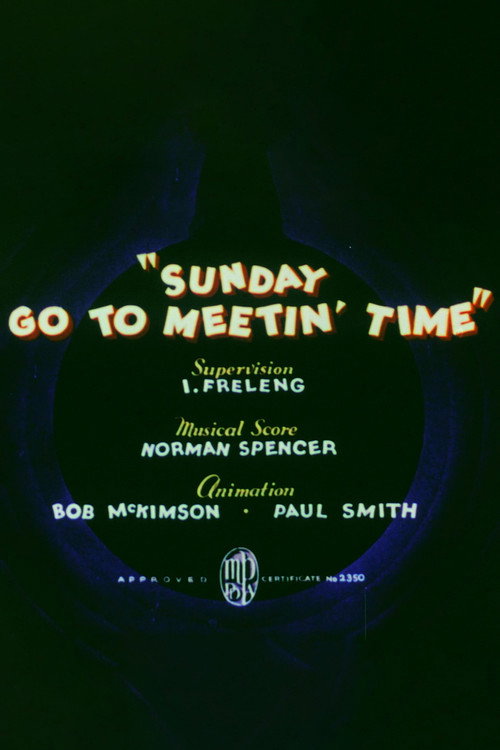
Sunday Go to Meetin' Time 1936
Directed by animation legend Friz Freleng and released in 1936, *Sunday Go to Meetin' Time* is a controversial short that blends dark comedy with troubling stereotypes.
Director: Friz Freleng
Cast
Frequently Asked Questions
What is Sunday Go to Meetin' Time (1936) about?
The film centers on a man who sneaks out of church to steal a chicken, only to wind up in a surreal nightmare after being knocked unconscious. His guilt-ridden conscience manifest as a hellish punishment, blending dark humor with problematic stereotypes.
Who directed Sunday Go to Meetin' Time?
Sunday Go to Meetin' Time was directed by Friz Freleng, a pioneering animator and director known for his work with Warner Bros. during the Golden Age of Animation.
Who stars in Sunday Go to Meetin' Time?
The short features Gus Wicke in the lead role, supported by uncredited voice actors typical of the era's studio animation.
Is Sunday Go to Meetin' Time (1936) worth watching?
As a historical artifact, *Sunday Go to Meetin' Time* offers insight into early animation's creative risks, but its outdated stereotypes make it a challenging watch. Fans of vintage cartoons may find it intriguing, though its content is undeniably problematic by modern standards.
How long is Sunday Go to Meetin' Time?
The cartoon runs for approximately 7 minutes.
About Sunday Go to Meetin' Time (1936) — A 1936 Warner Bros. cartoon steeped in controversy
Directed by animation legend Friz Freleng and released in 1936, *Sunday Go to Meetin' Time* is a controversial short that blends dark comedy with troubling stereotypes. The film follows a churchgoer who sneaks away from a service only to face chaotic consequences after attempting to steal a chicken. Knocked unconscious, he's plunged into a surreal vision of hellfire and brimstone—a surreal twist that mixes slapstick humor with an unsettling tone. The seven-minute cartoon sits in the awkward space between early animation's bold creativity and the insensitive portrayals that would later define the infamous "Censored 11."
This lost relic of 1930s animation offers a fascinating but problematic glimpse into the era's comedic sensibilities, where racial caricatures were often played for laughs without regard for their lasting impact. Shot in black-and-white with minimal dialogue, the film relies on exaggerated visuals and exaggerated characterizations that reflect the era's flawed storytelling. While it captures a specific moment in animation history, its legacy is complicated by the racist stereotypes that led to its ban from television syndication decades later.