
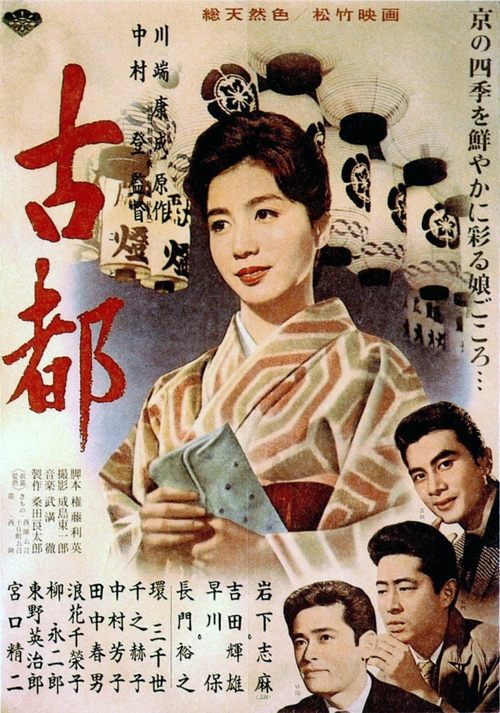
Twin Sisters of Kyoto 1963
Noboru Nakamura's Twin Sisters of Kyoto (1963) unveils a quietly gripping drama set against the rustic backdrop of rural Japan, where tradition clashes with human longing.
Director: Noboru Nakamura
Cast

Shima Iwashita
Chieko / Naeko

Seiji Miyaguchi
Takichiro Sada
Yoshiko Nakamura
Shige

Hiroyuki Nagato
Hideo Otomo

Teruo Yoshida
Ryusuke Mizuki

Tamotsu Hayakawa
Shinichi Mizuki

Eijirō Tōno
Sosuke Otomo

Michiyo Tamaki
Masako

Kakuko Chino
Geisha Girl
Junko Hara
Frequently Asked Questions
What is Twin Sisters of Kyoto (1963) about?
The film follows a merchant's daughter who discovers she has a twin sister, abandoned at birth due to old superstitions. After learning her family lied about the sister's fate, she embarks on a journey that leads to a reunion filled with love, doubt, and emotional reckoning.
Who directed Twin Sisters of Kyoto?
The film was directed by Noboru Nakamura, known for his sensitive, character-driven dramas set in postwar Japan.
Who stars in Twin Sisters of Kyoto?
The lead roles are played by Shima Iwashita and Yoshiko Nakamura, supported by Seiji Miyaguchi, Hiroyuki Nagato, and Teruo Yoshida.
Is Twin Sisters of Kyoto (1963) worth watching?
Though unrated, this drama offers a slow-burning, emotionally rich narrative rooted in cultural themes. Fans of classic Japanese cinema and character studies will find its subtle storytelling rewarding, even if it may not appeal to those seeking fast-paced action.
How long is Twin Sisters of Kyoto?
Twin Sisters of Kyoto runs for 106 minutes.
About Twin Sisters of Kyoto (1963) — A Hidden Bond That Defies Tradition
Noboru Nakamura's Twin Sisters of Kyoto (1963) unveils a quietly gripping drama set against the rustic backdrop of rural Japan, where tradition clashes with human longing. The story follows a modest dry goods merchant's daughter who stumbles upon the revelation of a long-lost twin sister, abandoned at birth due to the superstition that twins bring misfortune. When the merchant's family fabricates a kidnapping to conceal the truth, the daughter sets out on a quest for the truth that leads her to a fateful reunion. Their paths intertwine with passionate love affairs—one with a scholarly suitor whose motives remain clouded in doubt—sparking a delicate balance of hope, suspicion, and emotional discovery.
With its delicate pacing and understated intensity, the film explores themes of identity, fate, and the societal pressures that once dictated personal choices. The lush cinematography and nuanced performances by Shima Iwashita and Yoshiko Nakamura immerse viewers in a world where the past lingers like a shadow, and every action carries the weight of tradition. Twin Sisters of Kyoto (1963) is a poignant reflection on connection and consequence, wrapped in the serene beauty of classic Japanese cinema.