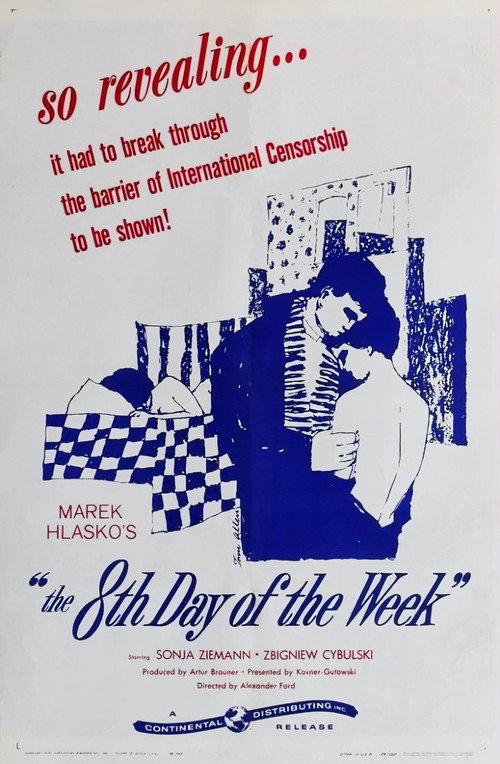
The Eighth Day of the Week 1958
Aleksander Ford's *The Eighth Day of the Week* (1958) is a poignant drama-romance set in the shadow of post-war Warsaw, where two lovers—played by Zbigniew Cybulski and Sonja Ziemann—yearn for privacy and happiness amid the city's crushing overcrowding.
Director: Aleksander Ford
Cast







Frequently Asked Questions
What is *The Eighth Day of the Week* (1958) about?
This drama-romance follows two lovers in 1950s Warsaw, where overcrowded living conditions and societal pressures make it nearly impossible for them to find peace or privacy. Their story becomes a metaphor for resilience, as they struggle to hold onto their dreams amid the chaos of a city still recovering from war.
Who directed *The Eighth Day of the Week*?
The film was directed by Aleksander Ford, a prominent figure in Polish cinema known for his socially conscious storytelling and visually striking films.
Who stars in *The Eighth Day of the Week*?
The lead roles are played by Sonja Ziemann and Zbigniew Cybulski, with Barbara Połomska, Ilse Steppat, and Emil Karewicz rounding out the ensemble cast.
Is *The Eighth Day of the Week* (1958) worth watching?
While it lacks an IMDb rating, *The Eighth Day of the Week* is a compelling historical drama with strong performances and a timeless message about love in adversity. Its rarity and critical significance make it a must-see for fans of Polish cinema and post-war storytelling.
How long is *The Eighth Day of the Week*?
The film runs for 83 minutes.
About The Eighth Day of the Week (1958) — A Forbidden Love Story in Post-War Warsaw
Aleksander Ford's *The Eighth Day of the Week* (1958) is a poignant drama-romance set in the shadow of post-war Warsaw, where two lovers—played by Zbigniew Cybulski and Sonja Ziemann—yearn for privacy and happiness amid the city's crushing overcrowding. Ford crafts a raw, intimate portrait of resilience, as the protagonists navigate the harsh realities of a war-torn society while clinging to their dreams of a brighter future. The film's stark atmosphere blends melancholy with fleeting moments of hope, reflecting the collective struggle of a generation rebuilding itself. With its emotionally charged storytelling and evocative visuals, this Polish gem captures the universal quest for love and stability in turbulent times.
Critically significant for its banned status in Poland upon release, *The Eighth Day of the Week* remained unseen domestically until its eventual European debut the following year. The movie's unflinching realism and poetic realism set it apart, offering a glimpse into a pivotal moment in cinematic history while resonating with themes of longing, survival, and the fragility of human connection.