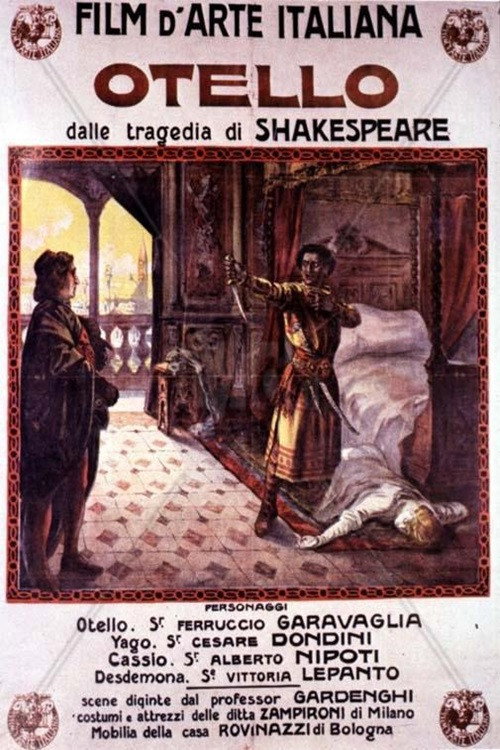
Othello 1909
Dive into the silent-era interpretation of Shakespeare's tragic masterpiece with Ugo Falena's 1909 version of *Othello*. This 12-minute adaptation strips back the grandeur of the original play to focus on the raw intensity of betrayal, jealousy, and love's destructive force.
Director: Ugo Falena
Cast
Frequently Asked Questions
What is Othello (1909) about?
This early silent adaptation condenses Shakespeare's tragic tale of Othello, the Moorish general, whose marriage to Desdemona is sabotaged by the cunning Iago. Driven by jealousy and false evidence, Othello's trust crumbles, leading to a devastating climax that questions the cost of suspicion and manipulation.
Who directed Othello?
Othello (1909) was directed by Ugo Falena, an Italian filmmaker known for his adaptations of classic literature and theatrical works.
Who stars in Othello?
The film features Ferruccio Garavaglia as Othello, Vittoria Lepanto as Desdemona, and Cesare Dondine as Iago, with supporting roles by Alberto Nepoti, Angelo Pezzaglia, and Mario Bonnard.
Is Othello (1909) worth watching?
As an early silent adaptation of a Shakespearean classic, *Othello (1909)* offers a unique historical perspective, though its brevity limits depth. It's best appreciated for its innovative storytelling and performances rather than as a standalone drama, making it a curiosity for classic film enthusiasts.
How long is Othello?
The film runs for approximately 12 minutes.
About Othello (1909) — Early Silent Adaptation of Shakespeare's Tragic Masterpiece
Dive into the silent-era interpretation of Shakespeare's tragic masterpiece with Ugo Falena's 1909 version of *Othello*. This 12-minute adaptation strips back the grandeur of the original play to focus on the raw intensity of betrayal, jealousy, and love's destructive force. Ferruccio Garavaglia delivers a commanding performance as the Moorish general, while Vittoria Lepanto embodies the tragic Desdemona, her innocence clashing with the venomous schemes of Cesare Dondine's Iago. Set against the stark black-and-white canvas of early cinema, the film captures the play's timeless themes of power, suspicion, and the fragility of human trust in a way that feels both intimate and haunting.
The atmosphere is thick with tension, the silent visuals amplifying every glance and gesture to convey emotions that words alone could not capture in 1909. Though stripped of dialogue, the film's storytelling is sharp, relying on expressive performances and tight framing to immerse viewers in Othello's descent into madness. It's a fascinating glimpse into how early filmmakers adapted Shakespeare, proving that even in its brevity, *Othello (1909)* packs an emotional punch that resonates across more than a century.