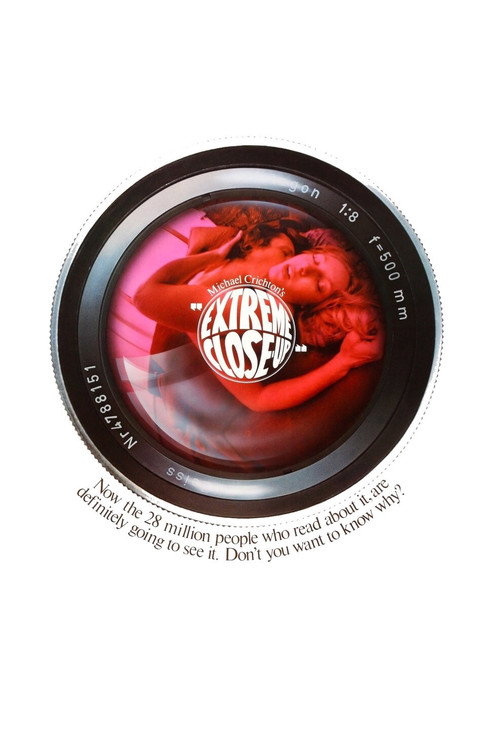
Extreme Close-Up 1973
"Now the 28 million people who read about it, are definitely going to see it. Don't you want to know why?"
In *Extreme Close-Up* (1973), director Jeannot Szwarc crafts a tense drama that pulls back the curtain on privacy invasion in the digital age.
Director: Jeannot Szwarc
Cast






Frequently Asked Questions
What is Extreme Close-Up (1973) about?
The film follows a TV reporter who conducts an undercover investigation into surreptitious surveillance by using hidden cameras and audio devices himself. His immersive experiment forces him to confront the psychological and ethical consequences of being watched without consent.
Who directed Extreme Close-Up?
Extreme Close-Up was directed by Jeannot Szwarc, a filmmaker known for his work across television and film during the 1970s and beyond.
Who stars in Extreme Close-Up?
The film features Jim McMullan in the lead role, supported by Katherine Woodville, James A. Watson, Jr., Bara Byrnes, and Al Checco.
Is Extreme Close-Up (1973) worth watching?
While the film isn't rated on IMDb, its ambitious themes and tight runtime make it a compelling watch for fans of 1970s dramas. It's especially intriguing for those interested in media ethics and the impact of technology on privacy.
How long is Extreme Close-Up?
Extreme Close-Up has a runtime of 80 minutes.
About Extreme Close-Up (1973) — A Reporter's Dive into the Dark Side of Surveillance
In *Extreme Close-Up* (1973), director Jeannot Szwarc crafts a tense drama that pulls back the curtain on privacy invasion in the digital age. The film follows a determined television reporter who immerses himself in the unsettling world of surreptitious surveillance by renting covert cameras and tapping devices, seeking firsthand insight into how it feels to be watched without consent. As he delves deeper into the experiment, the line between observer and observed blurs, revealing the psychological toll of being under constant scrutiny. With its claustrophobic atmosphere and thought-provoking themes, *Extreme Close-Up* (1973) challenges audiences to reflect on the erosion of personal boundaries in an era when information—no matter how intrusive—moves at the speed of light.
Szwarc's gripping narrative, paired with a compelling lead performance, transforms what could have been a simple cautionary tale into a gripping exploration of trust, ethics, and the hidden dangers of modern technology. The film's short runtime belies its ambitious scope, making it a compelling watch for anyone intrigued by the intersection of journalism, surveillance, and human vulnerability.