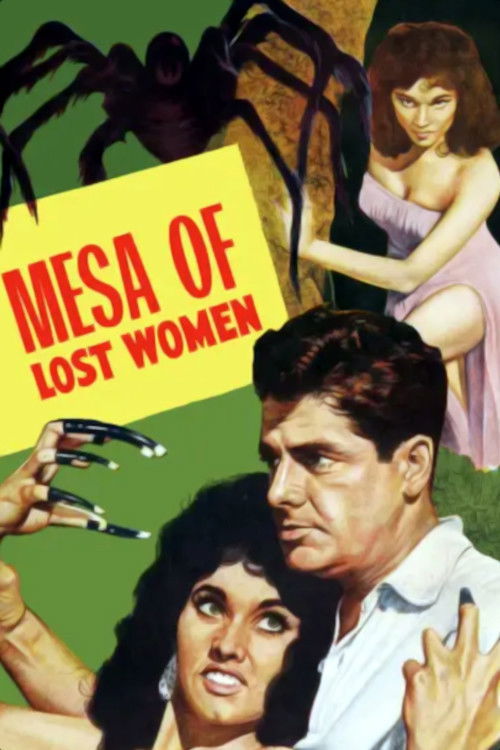
Mesa of Lost Women 1953
"A race of deadly spider-women luring men to their death!"
Dive into the bizarre 1953 cult classic *Mesa of Lost Women*, directed by Herbert Tevos, where mad science meets eerie Mexican landscapes in a tale of transformation and terror. Jackie Coogan stars as the enigmatic Dr.
Director: Herbert Tevos
Cast








Frequently Asked Questions
What is Mesa of Lost Women (1953) about?
This 1953 sci-fi horror film follows Dr. Aranya, a mad scientist in a remote Mexican desert who experiments with injecting spiders with human pituitary hormones. The result? A new race of superwomen with regenerative powers, while his male victims mutate into grotesque, stunted dwarves.
Who directed Mesa of Lost Women?
Herbert Tevos directed *Mesa of Lost Women*, helming this offbeat blend of horror and science fiction that leans heavily into 1950s pulp aesthetics.
Who stars in Mesa of Lost Women?
The film features Jackie Coogan in a standout lead role, alongside Allan Nixon, Richard Travis, Lyle Talbot, and Paula Hill in pivotal supporting parts.
Is Mesa of Lost Women (1953) worth watching?
While not a critical darling, *Mesa of Lost Women* offers a fascinating glimpse into early sci-fi horror with a unique premise and cult appeal. Its B-movie charm and bizarre body horror make it a must-watch for fans of vintage exploitation cinema, even if it's more ridiculous than refined.
How long is Mesa of Lost Women?
Mesa of Lost Women runs for 69 minutes, packing its wild spider-themed narrative into a brisk runtime perfect for a double feature or late-night viewing.
🎥 Trailer
About Mesa of Lost Women (1953) — A Mad Scientist's Spider-Inspired Horror Experiment
Dive into the bizarre 1953 cult classic *Mesa of Lost Women*, directed by Herbert Tevos, where mad science meets eerie Mexican landscapes in a tale of transformation and terror. Jackie Coogan stars as the enigmatic Dr. Aranya, a scientist obsessed with merging human and arachnid biology in his remote Zarpa Mesa lab. By injecting pituitary growth hormones into spiders, he crafts a race of superwomen with regenerative abilities—while his male victims face grotesque mutations, shrinking into disfigured dwarves. As the spiders evolve to human-scale intelligence, the film weaves a dark, pulpy atmosphere thick with 1950s sci-fi dread and horror tropes.
This low-budget gem blends science fiction and horror in a way that feels both campy and oddly compelling, with a visual style that leans into its B-movie roots. Themes of hubris, gender dynamics, and the unnatural tampering with nature give it an undercurrent of social commentary, even if the execution is gloriously unhinged. Perfect for fans of vintage exploitation cinema or anyone curious about the wild fringes of early horror-fantasy storytelling.