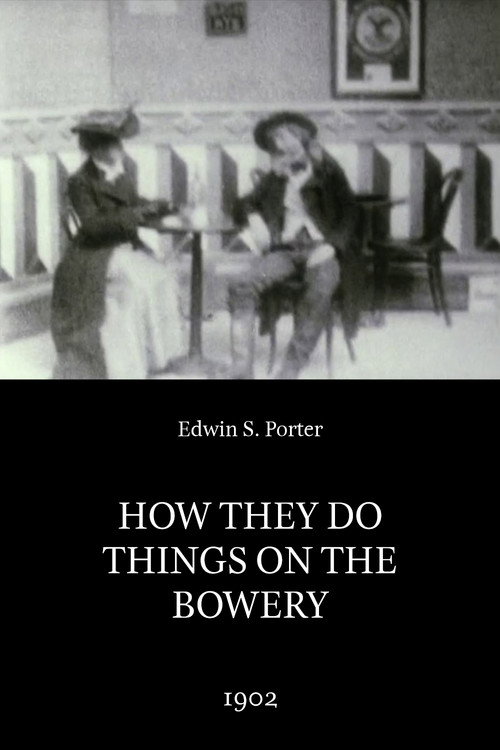
How They Do Things on the Bowery 1902
Step back to 1902 and witness one of early cinema's most audacious short films, Edwin S. Porter's *How They Do Things on the Bowery*.
Director: Edwin S. Porter
Frequently Asked Questions
What is *How They Do Things on the Bowery* (1902) about?
The film follows a clever woman in New York's Bowery who lures an unsuspecting newcomer into a saloon, drugs him, and steals his valuables before disappearing. Left humiliated and robbed, the victim vents his rage on the bartender in a brief but intense confrontation. It's a sharp, morality tale disguised as a silent-era short.
Who directed *How They Do Things on the Bowery*?
The film was directed by Edwin S. Porter, a pioneer of American cinema who played a key role in shaping early narrative filmmaking through his innovative storytelling techniques.
Who stars in *How They Do Things on the Bowery*?
The cast details for this 1902 silent short are not recorded, but the film is known for its focused performances in line with early film conventions.
Is *How They Do Things on the Bowery* (1902) worth watching?
As one of the earliest surviving narrative films, *How They Do Things on the Bowery* is more valuable as a historical curiosity than a modern viewing experience. Its brevity and silent-era style may feel dated, but it offers a fascinating look at how cinema began telling stories through images and action alone.
How long is *How They Do Things on the Bowery*?
The film runs for approximately 1 minute.
About How They Do Things on the Bowery (1902) — A 1902 Silent Drama That Shows the Bowery's Dark Charm
Step back to 1902 and witness one of early cinema's most audacious short films, Edwin S. Porter's *How They Do Things on the Bowery*. Set in the lively, sometimes treacherous streets of New York's Bowery district, this silent-era drama unfolds with surprising efficiency in just under a minute. The story centers on a quick-witted woman whose charm and cunning turn the tables on a trusting newcomer, the so-called "Rube," leading to a classic tale of deception and comeuppance. Porter's direction is sharp for the era, using minimal cuts to maximize suspense and moral irony, capturing the raw energy and moral ambiguities of early 20th-century urban life.
The film's fast-moving plot and stark themes—trust, exploitation, and the illusion of safety—make it a fascinating artifact of silent cinema. Its tight structure and unspoken tension are hallmarks of Porter's groundbreaking style, paving the way for the narrative techniques that would define American filmmaking. Whether you're a student of film history or a fan of vintage storytelling, *How They Do Things on the Bowery (1902)* offers a glimpse into the birth of cinematic storytelling, where every frame carried a punch.