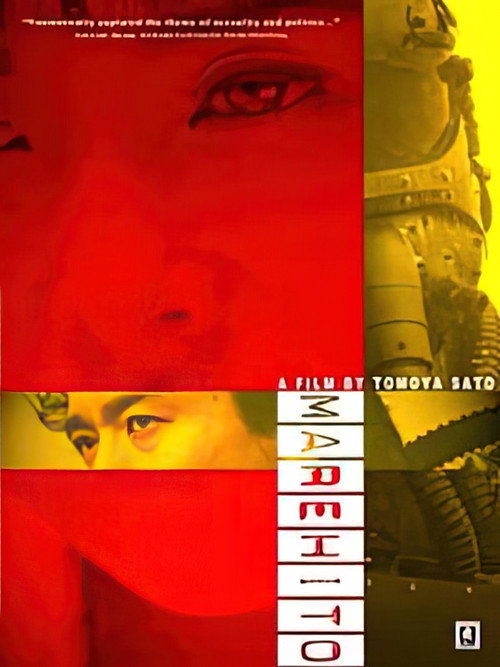
Marehito 1995
In Tomoya Sato's *Marehito (1995)*, a solitary soldier stationed at a peaceful border post finds himself trapped in a monotonous routine, surveilling broadcasts from across enemy lines.
Director: Tomoya Sato
Cast


Frequently Asked Questions
What is Marehito (1995) about?
*Marehito (1995)* follows a soldier stationed at a border post who monitors radio speeches from the enemy leader Marehito. His uneventful routine is disrupted only by the arrival of a government-issued android companion, as he grapples with the monotony of his duty and the emptiness of the propaganda he's forced to listen to.
Who directed Marehito?
*Marehito (1995)* was directed by Tomoya Sato, a filmmaker whose work often explores themes of isolation and societal control within speculative settings.
Who stars in Marehito?
The cast of *Marehito (1995)* includes Tenkwaku Naniwa, Yumi Mitani, Koichiro Mitsuda, and Hideyo Amamoto, with the latter voicing the titular Marehito.
Is Marehito (1995) worth watching?
As a short sci-fi film, *Marehito (1995)* offers a moody and thought-provoking take on propaganda and surveillance, though its runtime may limit its impact. It's best suited for fans of cerebral, atmospheric storytelling rather than high-octane action.
How long is Marehito?
*Marehito (1995)* has a runtime of 30 minutes.
🎥 Trailer
About Marehito (1995) — A soldier's quiet rebellion against propaganda and solitude
In Tomoya Sato's *Marehito (1995)*, a solitary soldier stationed at a peaceful border post finds himself trapped in a monotonous routine, surveilling broadcasts from across enemy lines. The speeches emanating from the dictator Marehito—voiced by Hideyo Amamoto—drip with uninspired propaganda, a constant reminder of the oppressive political climate he's meant to uphold. His isolation is further deepened by the presence of a government-issued android companion, a 'comfort woman' designed to ease his loneliness, yet unable to break the suffocating silence of his duty. This short sci-fi film blends quiet existential dread with sharp social commentary, painting a bleak portrait of duty without purpose.
The soldier's quiet rebellion lies not in defiance, but in his growing disdain for Marehito's hollow rhetoric, which seeps into his quarters like a ghostly infiltration. As the boundary between duty and disillusionment blurs, *Marehito (1995)* becomes a meditation on control, surveillance, and the fragile line between obedience and apathy. With its minimalist storytelling and eerie atmosphere, Sato's film lingers like an unresolved transmission, leaving viewers to question who's really in power—and who's just a pawn in the game.