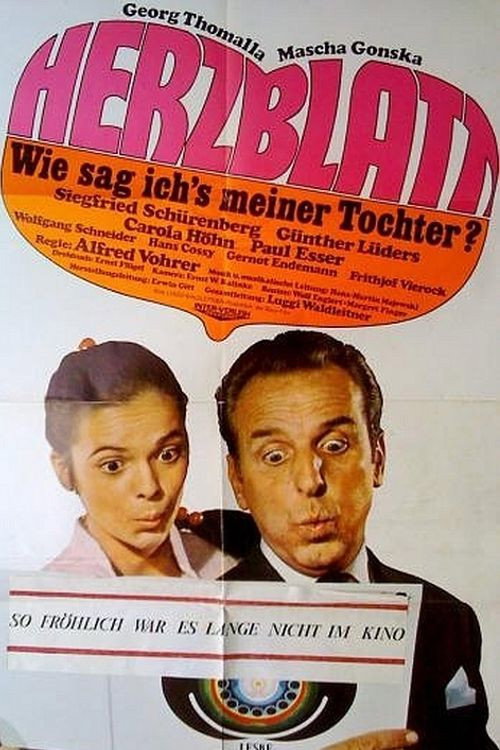
Herzblatt oder wie sag' ich's meiner Tochter? 1969
In the charming West German comedy *Herzblatt oder wie sag' ich's meiner Tochter? (1969)* directed by Alfred Vohrer, a well-meaning but reluctant widower named Paul faces a modern dilemma no parent expects.
Director: Alfred Vohrer
Cast









Frequently Asked Questions
What is *Herzblatt oder wie sag' ich's meiner Tochter? (1969)* about?
This West German comedy follows a widower who tries to teach his teenage daughter about relationships by arranging a boyfriend for her—only to find himself entangled in a series of awkward and comedic situations. The film mixes parental concerns with humorous misunderstandings in a classic 1960s setting.
Who directed *Herzblatt oder wie sag' ich's meiner Tochter? (1969)*?
The film was directed by Alfred Vohrer, a prolific German filmmaker known for his work in crime and comedy genres.
Who stars in *Herzblatt oder wie sag' ich's meiner Tochter? (1969)*?
The main cast includes Georg Thomalla, Mascha Gonska, Paul Esser, Carola Höhn, and Günther Lüders in pivotal roles.
Is *Herzblatt oder wie sag' ich's meiner Tochter? (1969)* worth watching?
As a lighthearted comedy from 1969, it offers nostalgic charm and humorous takes on generational gaps. While not a modern blockbuster, its playful tone and classic German cinema vibe make it a fun watch for fans of vintage comedies.
How long is *Herzblatt oder wie sag' ich's meiner Tochter? (1969)*?
The runtime is 79 minutes.
About Herzblatt oder wie sag' ich's meiner Tochter? (1969) — Comedy Classic Explores Parenting and Puberty
In the charming West German comedy *Herzblatt oder wie sag' ich's meiner Tochter? (1969)* directed by Alfred Vohrer, a well-meaning but reluctant widower named Paul faces a modern dilemma no parent expects. When his 16-year-old daughter's sunbathing antics on a nearby construction site cause a comical chain of scaffolding collapses, Paul realizes it's time to have *the talk*—but not the one about birds and bees. Instead, he takes a roundabout route, hoping to teach her the consequences of differences between boys and girls by finding her a suitable boyfriend.
This lighthearted yet clever farce blends classic comedic timing with a relatable coming-of-age theme, all wrapped in the cozy, nostalgic atmosphere of 1960s Germany. With its playful exploration of parental concern and adolescent curiosity, the film captures the awkward yet universal struggle between generations navigating love, life, and laughter.