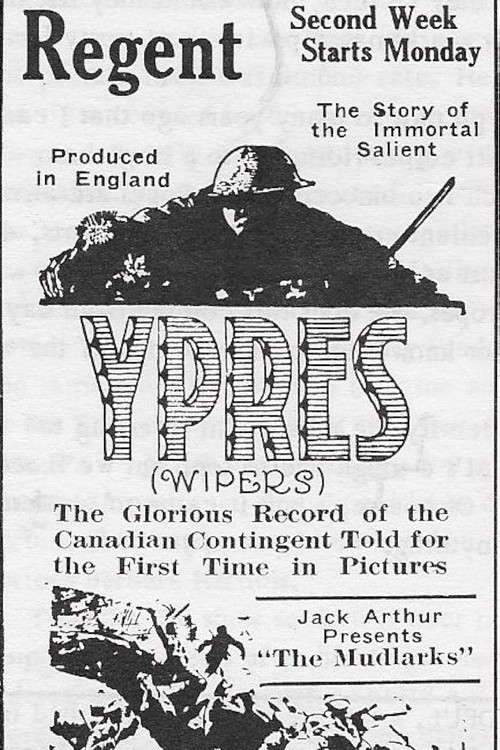
Ypres 1925
"The Story of the Immortal Salient"
Ypres (1925) is a silent-era war drama that reconstructs the harrowing five battles fought around the Belgian city of Ypres, where over a million British and Commonwealth soldiers perished.
Director: Walter Summers
Frequently Asked Questions
What is Ypres (1925) about?
This 1925 silent film recounts the five brutal battles fought near Ypres, Belgium, during World War I, where over 1.7 million soldiers lost their lives. Rather than relying solely on documentary footage, it stages dramatic recreations to honor the memory of those who fought in the war's bloodiest campaigns.
Who directed Ypres?
The film was directed by Walter Summers, a British filmmaker known for his work in early war cinema and historical reconstructions.
Who stars in Ypres?
Cast information for Ypres (1925) is not available, reflecting the era's focus on collective storytelling over individual star power.
Is Ypres (1925) worth watching?
For silent film enthusiasts and WWI historians, Ypres (1925) is a compelling watch—less for its narrative precision and more for its atmospheric, stylized portrayal of war. Its historical significance and unique production approach make it a curious relic of early cinema.
How long is Ypres?
The film runs for 105 minutes.
Ypres (1925): The Silent Film That Preserved the Immortal Salient — Full Movie Info
Ypres (1925) is a silent-era war drama that reconstructs the harrowing five battles fought around the Belgian city of Ypres, where over a million British and Commonwealth soldiers perished. Directed by Walter Summers under the banner of British Instructional Films, this 105-minute feature blends archival footage with dramatic reenactments to dramatize a pivotal chapter of World War I. Unlike contemporaneous documentaries that leaned on raw imagery, Ypres (1925) takes a stylized approach—what some might call "faked"—to deliver a cinematic meditation on sacrifice and endurance. Though it shares the propagandistic fervor of its era, the film endures as a fascinating artifact, blending historical reverence with early narrative cinema.
Crafted during a period when filmmakers were still wrestling with how to depict war's brutality on screen, Ypres emerges as both a memorial and a storytelling experiment. Its atmospheric recreations and thematic weight—centering on the resilience of those who fought in the "Immortal Salient"—offer a haunting visual record of a defining conflict. For silent film enthusiasts and history buffs alike, it remains a compelling, if unsettling, time capsule of early 20th-century cinema's power to shape collective memory.