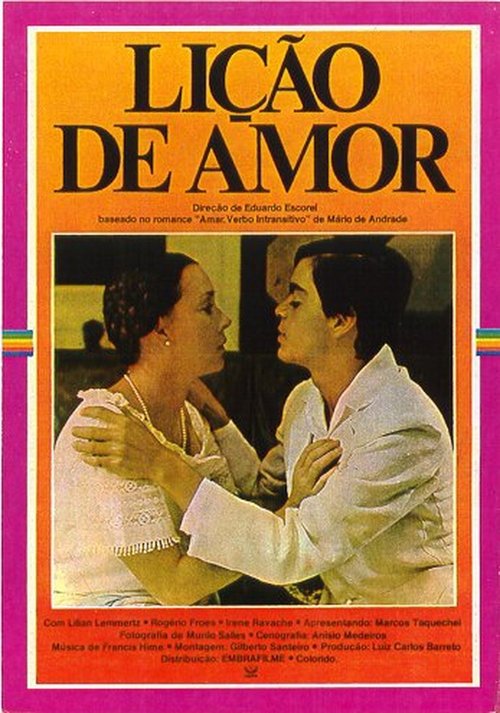
Love Lesson 1975
Set against the opulent backdrop of 1920s Brazil, Eduardo Escorel's *Love Lesson* unfolds as a quietly intense drama about unexpected connections.
Director: Eduardo Escorel
Cast


Frequently Asked Questions
What is Love Lesson (1975) about?
The film follows a German governess hired to teach a wealthy Brazilian teenager German and piano in the 1920s. Their lessons soon take an unexpected turn as emotional and physical boundaries dissolve, leading to a complex relationship that challenges societal norms.
Who directed Love Lesson?
Love Lesson was directed by Eduardo Escorel, a Brazilian filmmaker known for his intimate, character-driven dramas.
Who stars in Love Lesson?
The film features standout performances from Lilian Lemmertz, Irene Ravache, Rogério Fróes, and William Wu.
Is Love Lesson (1975) worth watching?
While unrated on IMDb, *Love Lesson* offers a compelling blend of drama and subtle romance set against a rich historical backdrop. Its themes of forbidden desire and personal growth make it a thought-provoking watch for fans of period pieces and character studies.
How long is Love Lesson?
Love Lesson has a runtime of 90 minutes.
About Love Lesson (1975) — A 1920s Brazilian drama of forbidden lessons and passion
Set against the opulent backdrop of 1920s Brazil, Eduardo Escorel's *Love Lesson* unfolds as a quietly intense drama about unexpected connections. The story follows a disciplined German governess hired to tutor a privileged teenage boy in German and piano, only for their lessons to evolve into something far more intimate. As boundaries blur, she becomes both mentor and muse, challenging his sheltered worldview with lessons that transcend language and music. The film masterfully captures a mood of restrained passion and social tension, where every glance and gesture hints at the forbidden desires simmering beneath the surface. With its rich atmosphere and nuanced performances, *Love Lesson* invites viewers into a world where tradition clashes with newfound awakening.
Lilian Lemmertz and Irene Ravache deliver standout performances as the governess and the boy's mother, respectively, grounding the film in emotional depth and authenticity. Escorel's direction weaves themes of forbidden love, class disparity, and the transformative power of mentorship into a slow-burn narrative that lingers long after the credits roll.