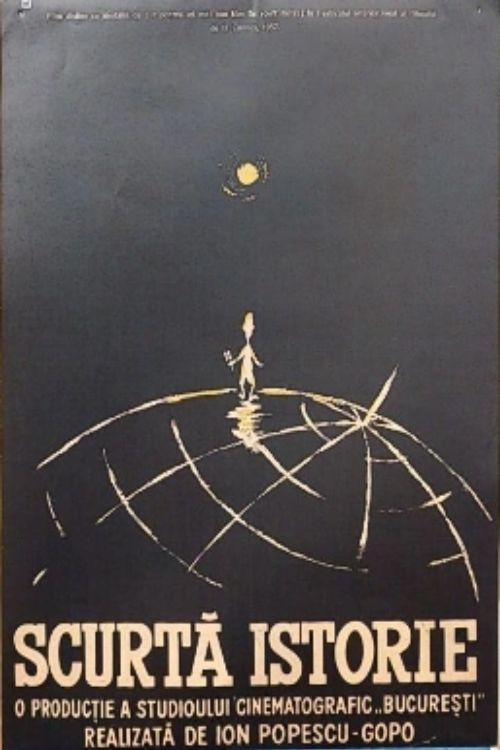
Brief History 1956
Directed by Romania's visionary animator Ion Popescu-Gopo, *Brief History* (1956) is a groundbreaking animated short that compresses the entire saga of human evolution into a mere eight minutes of breathtaking artistry.
Director: Ion Popescu-Gopo
Frequently Asked Questions
What is Brief History (1956) about?
*Brief History* distills the entire journey of humanity—from early lifeforms to modern civilization—into a compact animated adventure. With striking minimalism, it visualizes evolution as a dynamic, almost musical process, weaving biology, culture, and technology into a single, sweeping narrative.
Who directed Brief History?
The film was directed by Ion Popescu-Gopo, the renowned Romanian animator and pioneer of Eastern European animation whose innovative style left a lasting mark on global cinema.
Who stars in Brief History?
Cast details for *Brief History* are not publicly listed or widely documented.
Is Brief History (1956) worth watching?
As a Cannes Film Festival winner and a technical marvel of 1950s animation, *Brief History* is absolutely worth watching for film enthusiasts and history buffs alike. Its blend of artistic daring and scientific storytelling offers a unique viewing experience that remains fresh decades later.
How long is Brief History?
The runtime of *Brief History* is eight minutes.
About Brief History (1956) — A revolutionary 8-minute animation that traces human evolution and foreshadows space-age ambition
Directed by Romania's visionary animator Ion Popescu-Gopo, *Brief History* (1956) is a groundbreaking animated short that compresses the entire saga of human evolution into a mere eight minutes of breathtaking artistry. Far more than a scientific chronicle, this Cannes-winning film blends striking visuals with bold thematic strokes, capturing the ascent of humanity from primordial slime to self-aware civilization in a rhythm as hypnotic as it is informative. Set against the charged atmosphere of the 1950s, the film subtly mirrors the era's technological and ideological fervor—most notably foreshadowing the Soviet space triumph—while delivering a timeless meditation on progress and perspective.
At its core, Gopo's masterpiece transforms paleontology and anthropology into a cinematic journey, where each frame feels like a brushstroke on the canvas of evolution. The result is a mesmerizing, almost poetic condensation of time, rendered in stark black-and-white that amplifies every evolutionary leap and cultural shift. Viewers are left with not just knowledge, but a visceral sense of how far—and how quickly—we've come.