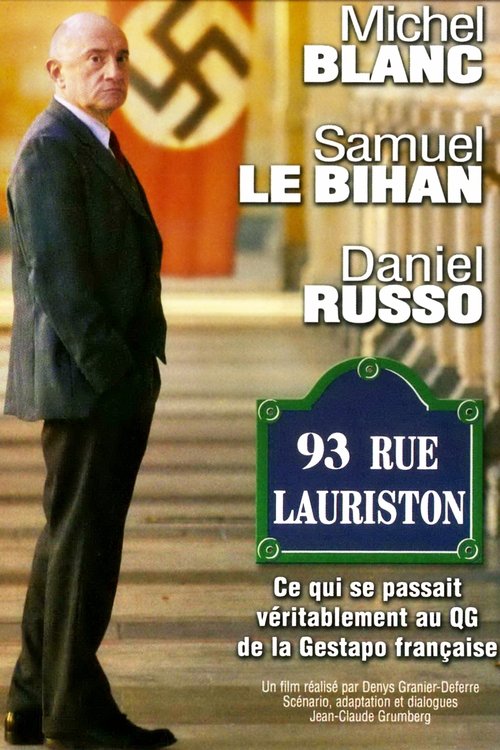
93, rue Lauriston 2004
Set in the shadowed streets of 1940s Paris, *93, rue Lauriston (2004)* plunges viewers into a gripping tale of moral ambiguity and wartime survival.
Director: Denys Granier-Deferre
Cast








Frequently Asked Questions
What is 93, rue Lauriston (2004) about?
The film follows Léon Jabinet, an ordinary man whose life spirals into danger when he shelters Odile Panzer, a Jewish girl, while unknowingly becoming entangled with the French Gestapo operating from 93, rue Lauriston. As Paris falls under occupation, Léon's choices force him into a moral tightrope between survival and complicity.
Who directed 93, rue Lauriston?
Denys Granier-Deferre directed *93, rue Lauriston*, bringing a stark and immersive approach to this historical crime drama.
Who stars in 93, rue Lauriston?
The film features Michel Blanc, Samuel Le Bihan, Gérald Laroche, Daniel Russo, and Christian Charmetant in pivotal roles.
Is 93, rue Lauriston (2004) worth watching?
With its tense atmosphere and exploration of moral dilemmas, *93, rue Lauriston* offers a compelling watch for fans of historical crime dramas. While not widely rated, its themes and direction make it a thought-provoking choice for viewers interested in wartime narratives.
How long is 93, rue Lauriston?
The runtime of *93, rue Lauriston* is 109 minutes.
About 93, rue Lauriston (2004) — A gripping crime drama set in wartime Paris
Set in the shadowed streets of 1940s Paris, *93, rue Lauriston (2004)* plunges viewers into a gripping tale of moral ambiguity and wartime survival. Directed by Denys Granier-Deferre, this crime drama weaves a tense narrative around Léon Jabinet, an ordinary man whose life takes a dark turn when he unwittingly becomes entangled with the notorious French Gestapo. Operating from the infamous address in the 16th arrondissement, the headquarters of Henri Lafont and Pierre Loutrel, the film explores the chilling realities of collaboration and resistance. As Léon shelters Odile Panzer, a Jewish girl fleeing persecution, the line between heroism and complicity blurs, capturing the suffocating tension of a city under occupation. With its stark atmosphere and historical weight, the movie immerses audiences in a world where trust is a luxury and survival demands impossible choices.
Granier-Deferre's direction crafts a haunting portrait of collaboration and moral decay, anchored by a cast that brings depth to the era's complexities. The film's exploration of betrayal and resilience resonates long after the credits roll, offering a sobering yet compelling look at one of Paris's darkest chapters.