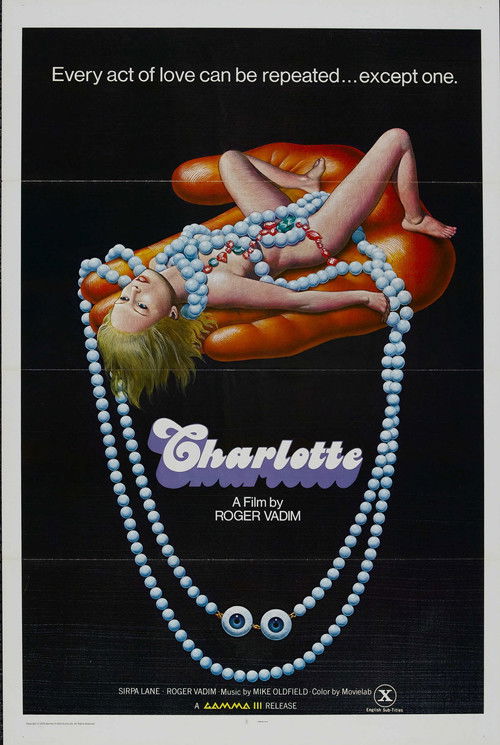
Charlotte 1974
"Every act of love can be repeated... except one."
Roger Vadim's Charlotte (1974) unfolds like a hypnotic journey into the darker corners of human desire, blending crime and drama into a provocative exploration of sex, death, and the boundaries between them.
Director: Roger Vadim
Cast








Frequently Asked Questions
What is Charlotte (1974) about?
Charlotte (1974) begins with a chilling murder that unravels into a meditation on life, death, and the extremes of human desire. The film traces a path where pushing boundaries leads to inevitable consequences, all set against a backdrop of moral and societal rebellion.
Who directed Charlotte?
Charlotte was directed by Roger Vadim, the French filmmaker celebrated for his bold and experimental approach to cinema, blending drama with themes of passion and transgression.
Who stars in Charlotte?
The film stars Sirpa Lane, Michel Duchaussoy, and Mathieu Carrière, with appearances from Roger Vadim himself and Elisabeth Wiener.
Is Charlotte (1974) worth watching?
With its daring themes and atmospheric storytelling, Charlotte (1974) offers a unique viewing experience for fans of crime dramas and provocative cinema. While it may not be for everyone, its bold narrative and Vadim's direction make it a standout in his filmography.
How long is Charlotte?
Charlotte has a runtime of 100 minutes.
Charlotte (1974): A Provocative Crime Drama by Roger Vadim — Full Movie Info
Roger Vadim's Charlotte (1974) unfolds like a hypnotic journey into the darker corners of human desire, blending crime and drama into a provocative exploration of sex, death, and the boundaries between them. The film opens with the chilling discovery of a murdered young woman, setting the stage for a narrative that peels back layers of time to reveal a philosophy where passion and mortality are stripped of taboos. Vadim, known for pushing cinematic limits, crafts an atmosphere thick with tension and moral ambiguity, where every act—no matter how extreme—feels like an inevitable consequence of pushing beyond societal norms.
As the story unravels, Charlotte (1974) becomes less about the crime itself and more about the culture of transgression that surrounds it. The film's themes resonate with a raw, almost obsessive energy, challenging viewers to confront the fragility of life and the seductive pull of living without limits. With its moody visuals and unflinching approach, this is a cult classic that lingers long after the credits roll, leaving audiences to question just where the line between freedom and destruction truly lies.