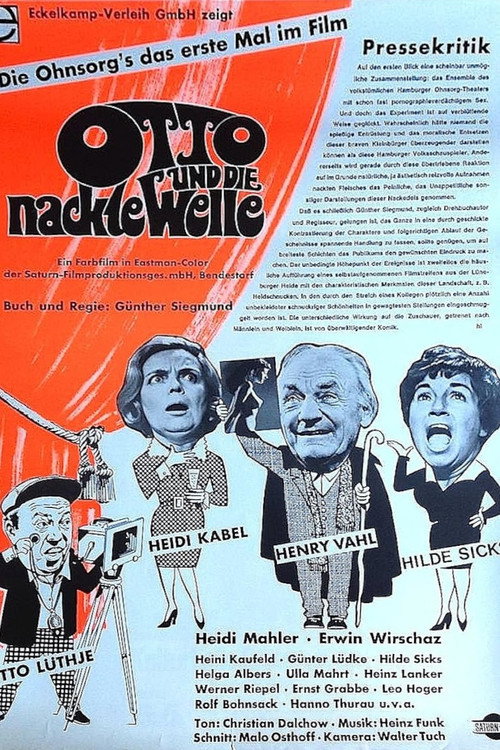
Otto und die nackte Welle 1968
In the vibrant city of Hamburg, Otto Sanftleben is fed up with the abundance of nudity surrounding him. Seeking a respite, he returns to the picturesque Lüneburg Heath, only to discover that even this idyllic setting has been invaded by nude bathers.
Director: Günther Siegmund
Cast

Frequently Asked Questions
What is Otto und die nackte Welle (1968) about?
The film follows Otto Sanftleben as he navigates a world where nudity has become increasingly commonplace, leading to a series of humorous and poignant encounters.
Who directed Otto und die nackte Welle?
Günther Siegmund brings his unique vision to the screen, crafting a comedy that is both a product of its time and a reflection of its era.
Who stars in Otto und die nackte Welle?
Otto Lüthje, Heidi Kabel, and Heidi Mahler lead the cast in this humorous exploration of societal norms.
Is Otto und die nackte Welle (1968) worth watching?
While the film's IMDb rating is not available, 'Otto und die nackte Welle' is a comedy that will appeal to fans of offbeat humor and those interested in the social commentary of the late 1960s.
How long is Otto und die nackte Welle?
The film has a runtime of 80 minutes.
About Otto und die nackte Welle (1968) — A Comedian's Quest for Sanity in a Changing World
In the vibrant city of Hamburg, Otto Sanftleben is fed up with the abundance of nudity surrounding him. Seeking a respite, he returns to the picturesque Lüneburg Heath, only to discover that even this idyllic setting has been invaded by nude bathers. As his filmmaker colleague becomes fascinated with capturing the naked women on camera, Otto must navigate the changing landscape of his beloved heath.
Günther Siegmund's 'Otto und die nackte Welle' is a comedy that pokes fun at the societal norms of the late 1960s. With a runtime of 80 minutes, this German film stars Otto Lüthje, Heidi Kabel, and Heidi Mahler, delving into themes of adaptation, tradition, and the blurring of lines between public and private spaces.
Experience the offbeat humor and poignant commentary of 'Otto und die nackte Welle (1968)' as it challenges the status quo in a bygone era.