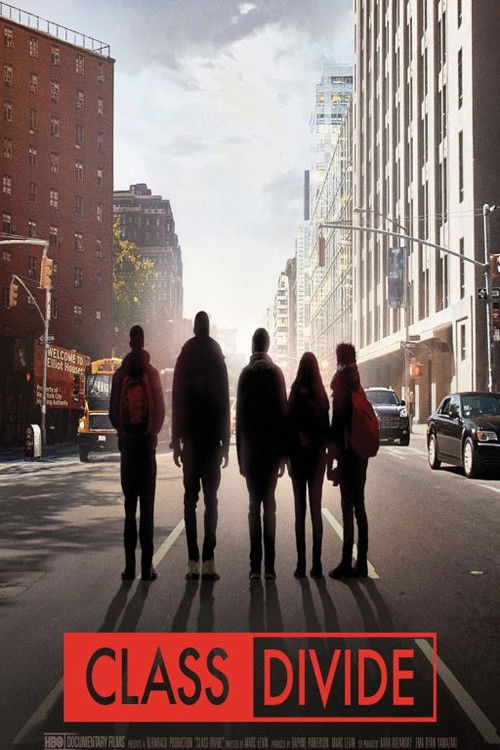
Class Divide 2016
Marc Levin's *Class Divide (2016)* peels back the curtain on New York City's stark economic divide through a gripping documentary that zeroes in on a single Chelsea intersection.
Director: Marc Levin
Frequently Asked Questions
What is Class Divide (2016) about?
*Class Divide* is a documentary that examines how gentrification and economic inequality play out in one New York City neighborhood. The film contrasts the lives of public housing residents at the Chelsea-Elliot Houses with students at the nearby private Avenues: The World School, exploring how these contrasting worlds collide and coexist.
Who directed Class Divide?
The film was directed by Marc Levin, a filmmaker known for his socially conscious documentaries that tackle urban issues and human stories with depth and urgency.
Who stars in Class Divide?
While the film focuses on the real-life residents and students at the heart of the story, specific cast details are not provided.
Is Class Divide (2016) worth watching?
*Class Divide* is a thought-provoking documentary that delivers a powerful commentary on inequality and gentrification. With its intimate storytelling and unflinching gaze at societal divides, it's a must-watch for fans of insightful, socially relevant films—even if it's not a crowd-pleaser in the traditional sense.
How long is Class Divide?
The documentary runs for 74 minutes.
🎥 Trailer
About Class Divide (2016) — A documentary on gentrification, inequality, and the stories of kids on opposite sides of 10th Avenue
Marc Levin's *Class Divide (2016)* peels back the curtain on New York City's stark economic divide through a gripping documentary that zeroes in on a single Chelsea intersection.
Here, the towering Chelsea-Elliot public housing projects stand in stark contrast to the sleek, tuition-fee private school Avenues: The World School, which moved in nearby in 2012. Levin's lens captures the raw, unfiltered experiences of young residents from both sides of 10th Avenue as they navigate the invisible yet impenetrable barriers of class and opportunity. The film transforms a microcosm into a powerful mirror reflecting broader societal fractures, exposing how gentrification reshapes lives, dreams, and futures in ways both subtle and seismic.