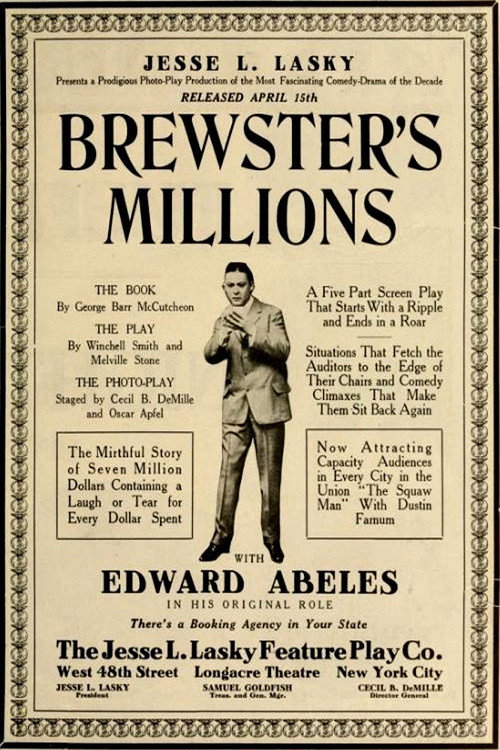
Brewster's Millions 1914
Brewster's Millions (1914), directed by the legendary Cecil B. DeMille, delivers a classic comedy premise wrapped in early silent-era charm.
Director: Cecil B. DeMille
Cast







Frequently Asked Questions
What is Brewster's Millions (1914) about?
Brewster's Millions (1914) follows a fortune-seeking man given a seemingly simple but impossible task: spend $1 million within two months to inherit an even larger fortune. The catch? He can't invest the money or gamble it away—just waste it, which proves trickier than it sounds.
Who directed Brewster's Millions?
Brewster's Millions (1914) was directed by Cecil B. DeMille, the pioneering filmmaker behind classics like *The Ten Commandments* and *The Squaw Man*.
Who stars in Brewster's Millions?
The film stars Edward Abeles as the ambitious protagonist, alongside Joseph Singleton, Sydney Deane, Mabel Van Buren, and Dick La Reno in key supporting roles.
Is Brewster's Millions (1914) worth watching?
While the film is now considered lost, its historical significance as the first adaptation of the famous novel makes it a must-know for comedy and silent-film enthusiasts. DeMille's direction ensures a lively, if now elusive, experience—best appreciated for its cultural impact rather than modern entertainment value.
How long is Brewster's Millions?
Brewster's Millions (1914) runs for 50 minutes, fitting neatly into a standard-era short film format.
About Brewster's Millions (1914) — The Original Comedy Challenge That Still Wows Today
Brewster's Millions (1914), directed by the legendary Cecil B. DeMille, delivers a classic comedy premise wrapped in early silent-era charm. This pioneering film adaptation follows a determined young man thrust into an absurd financial challenge: spend a staggering fortune in just 60 days to inherit an even larger sum. The story blends sharp wit with the chaotic energy of early 20th-century filmmaking, creating an atmosphere of playful desperation as our protagonist navigates reckless spending sprees and questionable investments. DeMille's direction lends the film a distinctive flair, balancing slapstick humor with moments of genuine tension.
As one of the first cinematic takes on this timeless tale—now a staple in comedy lore—the 1914 version of *Brewster's Millions* stands as both a historical curiosity and a testament to the enduring appeal of its central hook: the absurdity of wealth without rules. Though the film is considered lost today, its legacy lives on in later adaptations, proving that the struggle to waste money responsibly is a universal (and hilarious) challenge.