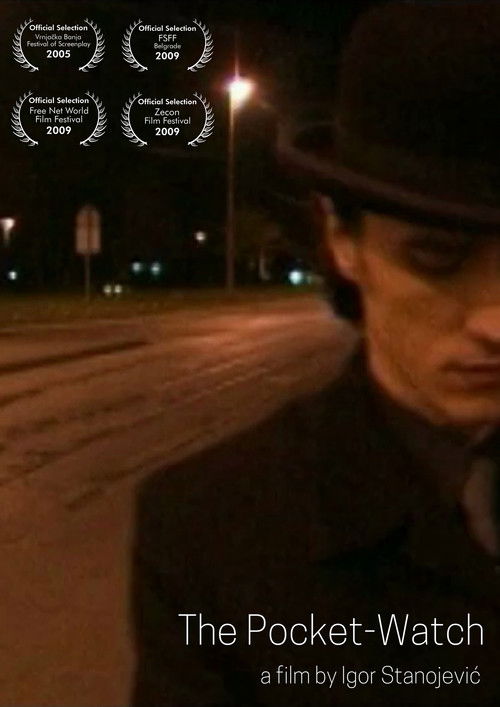
The Pocket-Watch 2005
In Igor Stanojević's eerie short film *The Pocket-Watch* (2005), time itself seems to unravel when an ordinary timepiece halts and a cinematic illusion shatters.
Director: Igor Stanojević
Cast

Frequently Asked Questions
What is The Pocket-Watch (2005) about?
This short film explores what happens when a man's pocket watch stops ticking—and the film itself seems to freeze in response. As time halts, reality distorts, dragging him into a surreal nightmare where the line between cause and effect dissolves.
Who directed The Pocket-Watch?
Igor Stanojević directed *The Pocket-Watch*; his atmospheric storytelling and experimental approach to time create a uniquely unsettling experience within just seven minutes.
Who stars in The Pocket-Watch?
Marko Marković headlines the cast, with Zoran Dikić and Željko Milosavljević rounding out the ensemble in key roles that heighten the film's chilling tone.
Is The Pocket-Watch (2005) worth watching?
At seven minutes long, *The Pocket-Watch* offers a bold, atmospheric dive into horror-sci-fi territory that rewards viewers seeking something uniquely unsettling. While its brevity limits deep character development, its creative execution and eerie premise make it a compelling watch for fans of avant-garde short films.
How long is The Pocket-Watch?
The Pocket-Watch runs for exactly 7 minutes.
About The Pocket-Watch (2005) — A Haunting Short Film on Time and Perception
In Igor Stanojević's eerie short film *The Pocket-Watch* (2005), time itself seems to unravel when an ordinary timepiece halts and a cinematic illusion shatters. Blending horror with science fiction, this seven-minute micro-feature plays with perception, weaving a haunting atmosphere where reality bends around a single, frozen moment. Marko Marković stars as a man whose world tilts when the mechanical pulse of his watch stalls, while Zoran Dikić and Željko Milosavljević deliver unsettling supporting performances that amplify the film's creeping dread. The narrative thrives on suspense, forcing viewers to question whether the disruption is mechanical—or something far more sinister.
Crafted with precision, *The Pocket-Watch* (2005) leans into the uncanny, where the boundaries between the tangible and the abstract dissolve like sand through fingers. Its themes of time's fragility and the fragility of human control resonate through stark visuals and a slow-burning tension that lingers long after the credits roll. A micro-budget marvel, the film proves that even the shortest stories can leave the deepest impressions when executed with such audacious creativity.