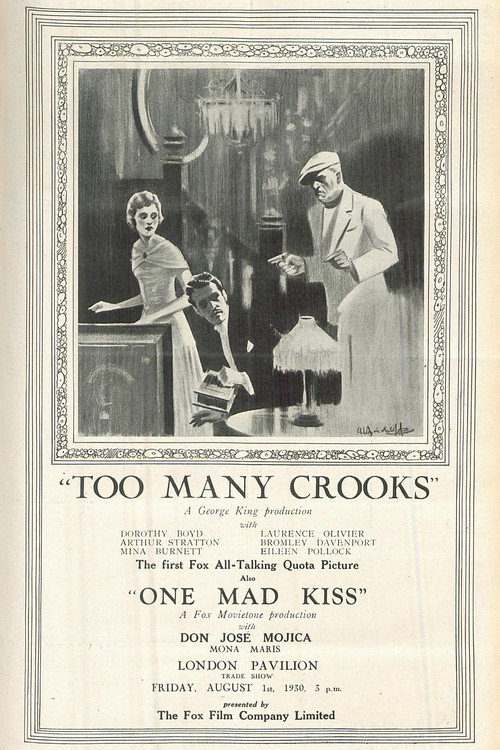
Too Many Crooks 1930
In the lively world of early 1930s British cinema, *Too Many Crooks* (1930) delivers a whirlwind of comedy and crime wrapped in a delightfully tangled plot.
Director: George King
Cast

Frequently Asked Questions
What is *Too Many Crooks* (1930) about?
*Too Many Crooks* follows a man who attempts to break into his own safe—only to discover a professional criminal has beaten him to it. What follows is a hilarious and chaotic night of crossed intentions, as the two thieves repeatedly cross paths in a series of comedic mishaps.
Who directed *Too Many Crooks*?
*Too Many Crooks* was directed by George King, a filmmaker known for his work in British cinema during the late silent and early sound eras.
Who stars in *Too Many Crooks*?
The film stars a young Laurence Olivier alongside Dorothy Boyd, with supporting roles from A. Bromley Davenport, Arthur Stratton, and Ellen Pollock.
Is *Too Many Crooks* (1930) worth watching?
While *Too Many Crooks* is an early talkie with limited runtime, its clever premise and Olivier's breakout performance make it a charming time capsule for fans of classic comedy and crime films. Its lighthearted tone and quick wit offer a delightful glimpse into 1930s cinema.
How long is *Too Many Crooks*?
*Too Many Crooks* runs for 38 minutes.
About Too Many Crooks (1930) — A Comic Crime Caper with Laurence Olivier
In the lively world of early 1930s British cinema, *Too Many Crooks* (1930) delivers a whirlwind of comedy and crime wrapped in a delightfully tangled plot. Directed by the underrated George King, this short film follows a man's desperate attempt to outwit a seasoned burglar—only to find himself locked in a high-stakes game of cat-and-mouse with his own safe. The story crackles with mischievous energy, blending slapstick humor with the thrill of a heist gone wrong, all unfolding in a single night of escalating chaos. With its snappy pacing and clever twists, *Too Many Crooks* showcases the charm of pre-Code cinema, where moral lines blur and laughter is as much a currency as the stolen loot.
Starring a young Laurence Olivier in one of his earliest screen roles, the film pairs his natural charisma with Dorothy Boyd for a dynamic on-screen duo that keeps the antics fresh and engaging. The genre-bending mix of comedy and crime feels ahead of its time, offering a playful yet sharp critique of ambition and folly. Set against the backdrop of 1930s London, the movie drips with atmosphere—think dimly lit apartments, clinking safes, and the unmistakable tension of a plan unraveling in real time.