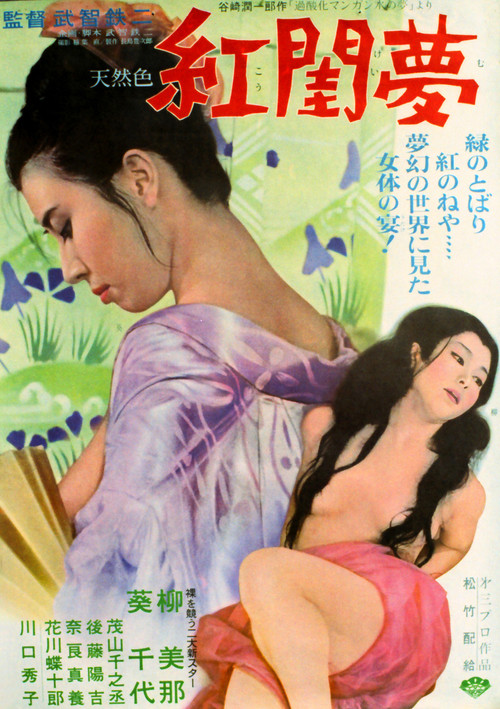
Crimson Dream 1964
Tetsuji Takechi's *Crimson Dream (1964)* plunges into the shadowy corners of the psyche, adapting two provocative short stories by Jun'ichirō Tanizaki into a moody, visually charged mystery-drama.
Director: Tetsuji Takechi
Cast

Frequently Asked Questions
What is Crimson Dream (1964) about?
*Crimson Dream* follows a writer, his wife, and his sister as their repressed desires spill into violent, erotic dreams after a night of drinking and provocative performances. The film blurs the line between fantasy and reality, plunging viewers into a surreal, nightmarish journey.
Who directed Crimson Dream?
*Crimson Dream* was directed by Tetsuji Takechi, a filmmaker known for pushing boundaries in Japanese cinema with bold, thematically rich productions.
Who stars in Crimson Dream?
The film features Mina Yanagi, Chiyo Aoi, and Sennojo Shigeyama, alongside Yokichi Gotou, Shin'yō Nara, and Chojuro Hanakawa.
Is Crimson Dream (1964) worth watching?
*Crimson Dream* is a fascinating but flawed artifact of 1960s Japanese cinema—its daring themes and atmospheric tension make it compelling for fans of mystery and horror, though its censorship and lost footage limit its impact today. If you're curious about Takechi's oeuvre, it's worth exploring, but manage expectations.
How long is Crimson Dream?
*Crimson Dream* has a runtime of 74 minutes.
About Crimson Dream (1964) — A lost erotic mystery-drama from Tetsuji Takechi
Tetsuji Takechi's *Crimson Dream (1964)* plunges into the shadowy corners of the psyche, adapting two provocative short stories by Jun'ichirō Tanizaki into a moody, visually charged mystery-drama. The film unravels the haunting, erotic dreams of a writer, his wife, and his sister after a night consumed by alcohol and unsettling erotic performances. Caught in a web of lust and violence, their subconscious visions blur the line between desire and nightmare, painting a portrait of repressed emotions erupting in vivid, often disturbing imagery.
Censored into obscurity before release, *Crimson Dream* lost nearly a fifth of its original footage—footage now vanished forever, leaving only fragments of its intended intensity. What remains is a daring exploration of taboo themes, where atmosphere weighs heavier than plot, and every frame pulses with the tension between restraint and excess. The result is a cult curiosity, a film that lingers like a half-remembered dream, as elusive as it is unforgettable.