Five 1951
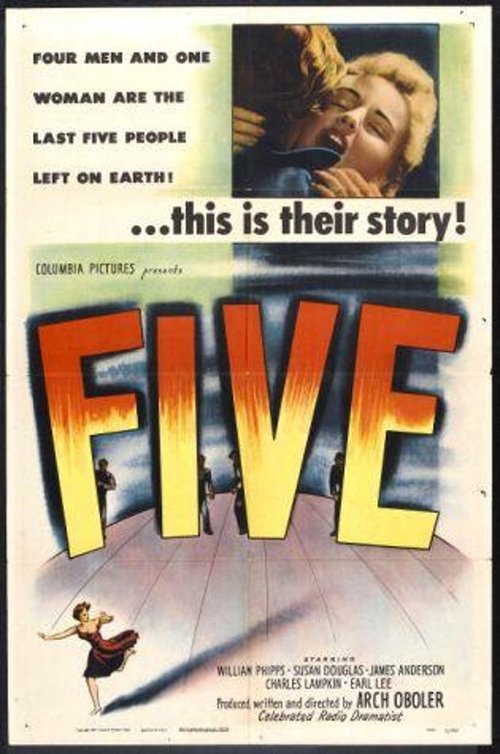
"Four men and one woman are the last five people on Earth...This is their story!"
In the chilling aftermath of an atomic catastrophe, *Five (1951)* drops four men and one woman into a hauntingly isolated hillside house, leaving them as the sole survivors of a world transformed.
Director: Arch Oboler
Cast

William Phipps
Michael

Susan Douglas
Roseanne Rogers

James Anderson
Eric

Charles Lampkin
Charles
Earl Lee
Mr. Barnstaple
Frequently Asked Questions
What is Five (1951) about?
Set in the wake of a devastating atomic bomb explosion, *Five* follows five strangers—four men and one woman—who become the last people on Earth. Stranded in a remote house, they must navigate survival while grappling with a future that feels increasingly uncertain with every passing day.
Who directed Five?
The film was directed by Arch Oboler, a pioneer in radio and early television whose work often explored human drama and survival.
Who stars in Five?
The film stars William Phipps, Susan Douglas, James Anderson, Charles Lampkin, and Earl Lee as the five survivors navigating a shattered world.
Is Five (1951) worth watching?
While *Five* isn't as widely known as some of its contemporaries, it's a gripping early example of post-apocalyptic storytelling with a focus on character over spectacle. Its raw, atmospheric tone will appeal to fans of vintage sci-fi and those interested in the psychological toll of survival.
How long is Five?
The film runs for 93 minutes.
🎥 Trailer
About Five (1951) — The Atomic Survival Story That Forged a Post-Apocalyptic Classic
In the chilling aftermath of an atomic catastrophe, *Five (1951)* drops four men and one woman into a hauntingly isolated hillside house, leaving them as the sole survivors of a world transformed. Directed by Arch Oboler, this early sci-fi drama weaves a tense tapestry of survival, hope, and human resilience amid the ruins of civilization. The survivors—each carrying their own burdens and fears—must confront not only the physical challenges of their new reality but the psychological weight of being among the last on Earth.
Arch Oboler crafts a stark, atmospheric narrative that lingers on themes of isolation, uncertainty, and the fragile bonds that form in crisis. With a minimalist yet evocative style, *Five (1951)* lingers between science fiction and psychological drama, offering a glimpse into a post-apocalyptic scenario that feels eerily prescient.