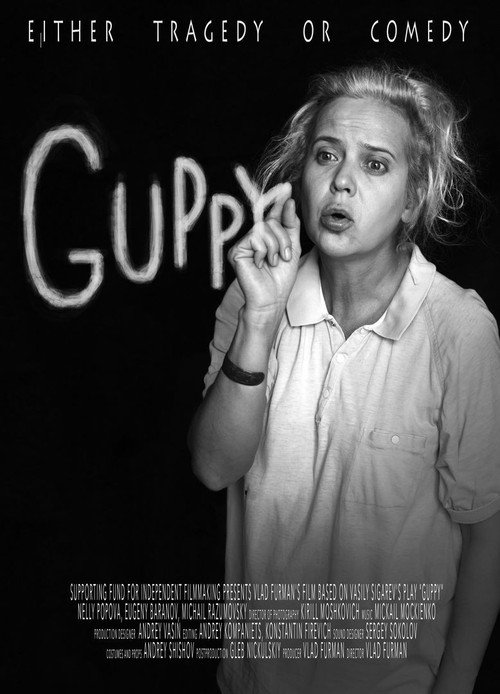
Guppy 2018
"Either Tragedy or Comedy"
Vlad Furman's *Guppy (2018)* dives into the quiet tensions of everyday life with a story that slips effortlessly between tragedy and comedy.
Director: Vlad Furman
Cast



Frequently Asked Questions
What is Guppy (2018) about?
The film centers on Tamara, a woman whose mundane evening is disrupted when her neighbor Pasha enters her apartment under flimsy pretenses. What begins as a simple visit spirals into an intimate confrontation about love, loneliness, and the quiet resentments of married life.
Who directed Guppy?
Vlad Furman is the director behind *Guppy*, guiding the film's sharp focus on character-driven drama.
Who stars in Guppy?
The cast features Nelli Popova as Tamara, Evgeniy Baranov as Pasha, and Mikhail Razumovsky as Lenechka.
Is Guppy (2018) worth watching?
While *Guppy* lacks an IMDb rating, its tight runtime and compelling performances make it a intriguing pick for fans of character-driven drama. The film's ability to balance humor and melancholy ensures it lingers in your mind long after the credits roll.
How long is Guppy?
The runtime for *Guppy* is 79 minutes.
About Guppy (2018): A Quiet Night Turns into a Struggle for Control
Vlad Furman's *Guppy (2018)* dives into the quiet tensions of everyday life with a story that slips effortlessly between tragedy and comedy. The film follows Tamara, a woman whose unassuming routine takes an unexpected turn when Pasha, a neighbor with a bottle of wine and unresolved thoughts, steps into her world. As the evening unfolds, the boundaries between hospitality and intrusion blur, revealing the fragility of Tamara's relationship with her husband, Lenechka, who once rescued her from rural obscurity but now treats her with detached affection. The apartment becomes a stage for raw, intimate confessions, where the weight of unspoken emotions hangs heavier than the trash Tamara never quite disposes of.
With its minimalist setting and sharp character dynamics, *Guppy* captures the absurdity and heartache of modern relationships. Furman's direction leans into the stark contrast between domesticity and drama, crafting a film that feels both painfully real and darkly humorous. The tagline 'Either Tragedy or Comedy' rings true—the line between laughter and tears is thinner than you'd expect.