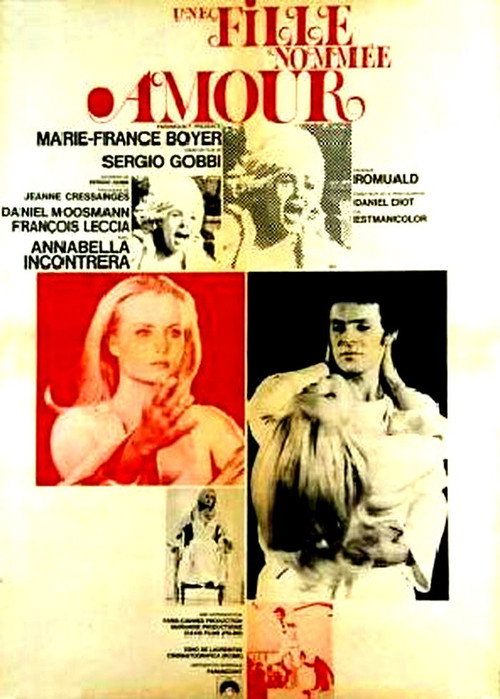
Une fille nommée Amour 1969
In the sultry Parisian backdrop of 1969, Sergio Gobbi's *Une fille nommée Amour* unfolds a sensual, slightly offbeat romance drenched in 60s cinematic flair.
Director: Sergio Gobbi
Cast




Frequently Asked Questions
What is Une fille nommée Amour (1969) about?
This French romance from 1969 follows a young woman recovering from an accident in her Parisian apartment, where she becomes entangled with a wounded Mardi Gras clown. Their encounters spark a relationship as mysterious as it is passionate, set against the backdrop of 1960s Parisian nightlife. The film weaves together themes of desire, chance, and the blurred lines between observer and participant.
Who directed Une fille nommée Amour?
Sergio Gobbi directed *Une fille nommée Amour*, a film that showcases his knack for blending romance with subtle suspense in a distinctly 60s European style.
Who stars in Une fille nommée Amour?
The film stars Marie-France Boyer in the lead role, supported by Daniel Moosmann, François Leccia, and Jean Luciani, who bring depth to its intimate yet edgy narrative.
Is Une fille nommée Amour (1969) worth watching?
While it may not be widely known today, *Une fille nommée Amour* offers a unique slice of 60s French romance with a dash of intrigue. Its short runtime and moody atmosphere make it a curious watch for fans of vintage European cinema, even if it leans more toward niche appeal than mainstream excitement.
How long is Une fille nommée Amour?
Une fille nommée Amour has a runtime of 85 minutes.
About Une fille nommée Amour (1969) — A 60s French Romance Blending Eroticism and Intrigue
In the sultry Parisian backdrop of 1969, Sergio Gobbi's *Une fille nommée Amour* unfolds a sensual, slightly offbeat romance drenched in 60s cinematic flair. The film centers on a young woman whose life pivots when a party game leaves her confined to a wheelchair in her apartment. Through binoculars, she spies a masked Mardi Gras clown embroiled in a mysterious scuffle, only for the clown himself to stumble into her life—first as an unexpected lover, then as a wounded fugitive seeking refuge. With its blend of eroticism, intrigue, and a touch of the surreal, the movie captures the era's restless spirit while exploring themes of desire, isolation, and chance encounters that blur reality and fantasy.
Sergio Gobbi crafts a story that's equal parts playful and haunting, where the boundaries between attraction and danger dissolve in the haze of Parisian nights. The film's moody cinematography and the lead performances—particularly Marie-France Boyer's portrayal of the voyeur-turned-protagonist—imbue *Une fille nommée Amour* with a distinctive, intoxicating charm. It's a snapshot of late-60s European cinema, where passion and unpredictability collide in the most unexpected ways.