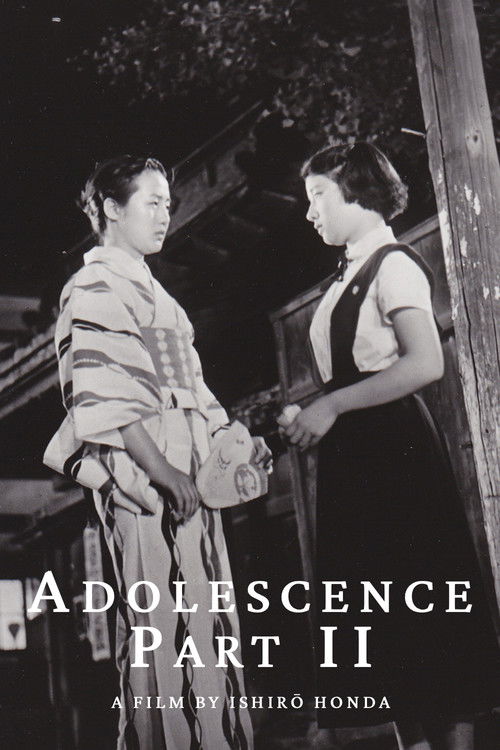
Adolescence Part II 1953
Directed by the legendary Ishirō Honda, *Adolescence Part II (1953)* dives into the raw emotional struggles of Japan's post-war youth, painting a stark portrait of discontent and missed opportunities.
Director: Ishirō Honda
Cast

Kyoko Aoyama
Reiko Mamiya

Tatsuyoshi Ehara
(uncredited)

Akira Kubo
(uncredited)

Keiko Miya
Tamae Konishi
Emiko Haino
Chiyoko Hori

Keiju Kobayashi
(uncredited)
Kieko Sawamura
Taeko Kawasaki

Chieko Nakakita
Kayo Konishi

Sachiko Murase
Kimi Mamiya

Eitarō Ozawa
Junzo Mamiya
Frequently Asked Questions
What is Adolescence Part II (1953) about?
*Adolescence Part II* captures the turbulent inner lives of young adults adrift in a society where guidance is scarce. Without proper sex education, their curiosity and frustrations spiral into poor decisions, leaving emotional scars that shape their futures.
Who directed Adolescence Part II?
The film was directed by Ishirō Honda, a master storyteller renowned for his ability to blend personal drama with social themes.
Who stars in Adolescence Part II?
The film features Kyoko Aoyama, Tatsuyoshi Ehara, Akira Kubo, Keiko Miya, and Emiko Haino in its core ensemble.
Is Adolescence Part II (1953) worth watching?
While unrated on IMDb, *Adolescence Part II* offers a compelling, if bleak, look at youth culture in post-war Japan. Its stark themes and Honda's direction make it a curious watch for drama enthusiasts, though it's not for those seeking lighthearted entertainment.
How long is Adolescence Part II?
The film runs for 88 minutes, a tight runtime that focuses its narrative with precision.
About Adolescence Part II (1953) — A Post-War Drama of Youth's Unseen Struggles
Directed by the legendary Ishirō Honda, *Adolescence Part II (1953)* dives into the raw emotional struggles of Japan's post-war youth, painting a stark portrait of discontent and missed opportunities. Set against a backdrop of societal transition, the film follows a group of restless teenagers navigating the murky waters of adolescence without the guidance of sex education—a void that leads to heartache, confusion, and reckless choices. Honda, known for his masterful storytelling, crafts a drama that's as thought-provoking as it is melancholic, capturing the era's generational divide with quiet intensity.
The movie's unflinching exploration of themes like isolation, reckless rebellion, and the consequences of unchecked impulses lingers long after the credits roll. With a runtime of just 88 minutes, *Adolescence Part II* moves at a brisk yet poignant pace, balancing intimate character moments with broader social commentary. The black-and-white cinematography adds a timeless, almost documentary-like quality, immersing viewers in a Japan still finding its footing in a rapidly changing world.