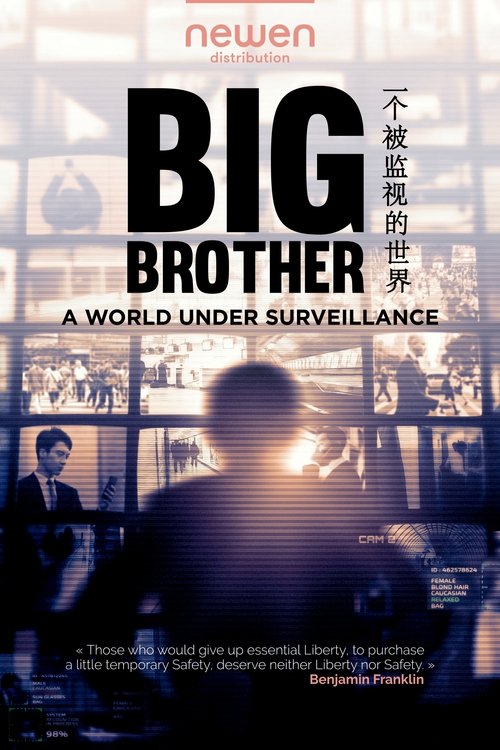
Big Brother: A World Under Surveillance 2020
"More security. Less freedom."
In *Big Brother: A World Under Surveillance (2020)*, director Sylvain Louvet pulls back the curtain on a chilling global trend—where nations justify unprecedented surveillance under the guise of safety.
Director: Sylvain Louvet
Cast
Frequently Asked Questions
What is *Big Brother: A World Under Surveillance* (2020) about?
The documentary explores how governments and corporations are using advanced surveillance technologies under the guise of security, often eroding personal freedoms in the process. It reveals how systems like facial recognition and citizen scoring are creating a new form of control, blending real-world examples with a dystopian vision of the future.
Who directed *Big Brother: A World Under Surveillance*?
The film was directed by Sylvain Louvet, a filmmaker known for his investigative documentaries on technology and society.
Who stars in *Big Brother: A World Under Surveillance*?
The documentary features Sylvain Louvet alongside experts like Sandra Bertin, Eylon Etshtein, and Hagar Shezaf, who provide insights into the surveillance landscape.
Is *Big Brother: A World Under Surveillance* (2020) worth watching?
Absolutely—if you're interested in the intersection of technology, privacy, and power, this documentary is a must-see. Its gripping exploration of real-world surveillance systems makes for a thought-provoking 90 minutes, even without a formal rating. The film's relevance and urgency give it a compelling edge.
How long is *Big Brother: A World Under Surveillance*?
The runtime is 90 minutes.
Big Brother: A World Under Surveillance (2020) — A Chilling Look at Modern Surveillance
In *Big Brother: A World Under Surveillance (2020)*, director Sylvain Louvet pulls back the curtain on a chilling global trend—where nations justify unprecedented surveillance under the guise of safety. From facial recognition to citizen rating systems, the film traces how technology once meant to protect has morphed into a tool of control, birthing what Louvet labels "numerical totalitarianism." Through interviews with experts like Eylon Etshtein and Hagar Shezaf, the documentary paints a dystopian reality eerily reminiscent of Orwell's *1984*, blending stark visuals with a palpable sense of unease. The 90-minute runtime races through real-world examples, from drone surveillance to emotion detectors, leaving viewers to question how much freedom we're willing to sacrifice for security.
Louvet's lens captures not just the mechanics of this surveillance state but its human cost, interviewing figures like General Isaac ben Israël to dissect the ethical dilemmas of a world where privacy is a fading relic. The film's atmosphere is tense and revelatory, a wake-up call for audiences to confront the balance—or imbalance—between safety and autonomy in the digital age.