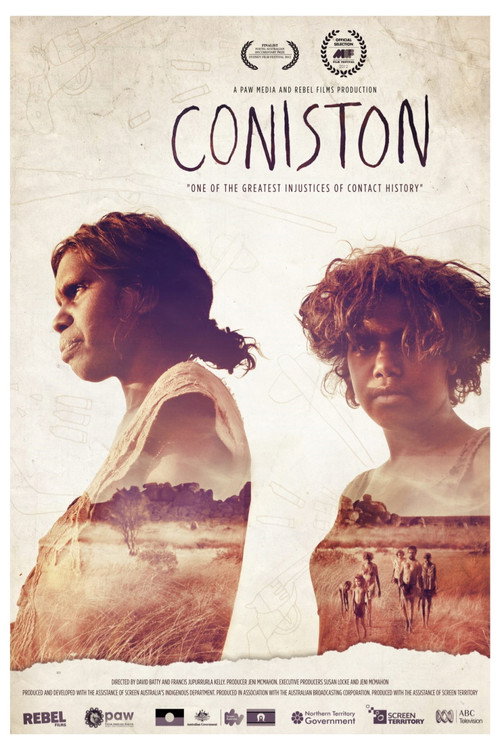
Coniston 2012
"More than 80 years after the brutal slaughter of 100 or more Aboriginal people in Central Australia, their descendants relate their story."
David Batty's *Coniston (2012)* is a gripping documentary that uncovers one of Australia's most harrowing historical injustices.
Director: David Batty
Cast
Frequently Asked Questions
What is *Coniston (2012)* about?
*Coniston* revisits the 1928 massacre in Central Australia, where over 100 Indigenous people were killed in retaliation for a white dingo trapper's murder. Survivors and their descendants recount the brutal events and their aftermath, revealing a suppressed history of colonial violence.
Who directed *Coniston*?
The documentary was directed by David Batty, who brings a sensitive yet uncompromising lens to this historical injustice.
Who stars in *Coniston*?
The film features Gregory J. Fryer and Leslie McLaughlin, alongside descendants and community members sharing their oral histories.
Is *Coniston (2012)* worth watching?
As a history documentary, *Coniston* is a must-watch for those interested in Indigenous narratives and Australia's colonial past. Its raw honesty and emotional weight make it compelling despite its heavy themes.
How long is *Coniston*?
The documentary runs for 55 minutes.
About Coniston (2012) — Documentary Exposing Australia's Last Indigenous Massacre
David Batty's *Coniston (2012)* is a gripping documentary that uncovers one of Australia's most harrowing historical injustices. In 1928, Central Australia became the site of the last known massacre of Indigenous people after a white dingo trapper was murdered, leading to brutal punitive expeditions that claimed over 100 lives. Survivors, displaced from their ancestral lands, carried the weight of this tragedy through generations, their stories silenced by official inquiries. Batty's film gives voice to descendants who share their family's painful legacy, blending archival insights with personal testimonies to expose a dark chapter often erased from history.
Set against the stark, haunting landscapes of Central Australia, *Coniston (2012)* weaves history with emotion, capturing the resilience of those who endured and survived. The documentary's unflinching approach challenges viewers to confront systemic oppression and the long-lasting scars of colonial violence.