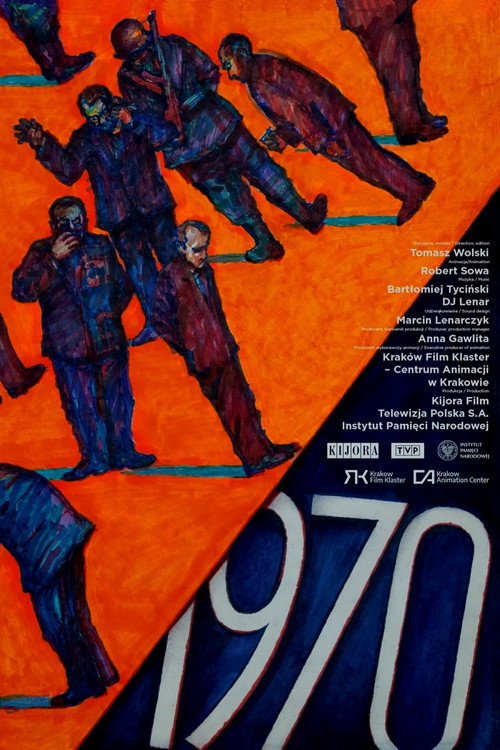
1970 2021
Tomasz Wolski's 1970 (2021) dives into one of Poland's most tense chapters, blending documentary grit with animated perspective to recount the brutal winter of 1970.
Director: Tomasz Wolski
Cast
Frequently Asked Questions
What is 1970 (2021) about?
This documentary-animation hybrid examines the 1970 protests in Poland, triggered by steep price hikes under communist rule. The film reconstructs the crisis through the eyes of the officials who orchestrated the violent crackdown, exposing the cold mechanics of state repression.
Who directed 1970?
Tomasz Wolski helms 1970, crafting a visually striking and thematically provocative take on Poland's authoritarian past.
Who stars in 1970?
The film features Kazimierz Świtała, Tadeusz Pietrzak, Ryszard Matejewski, Czesław Kiszczak, and Zdzisław Żandarowski as key figures within the regime's hierarchy.
Is 1970 (2021) worth watching?
Though unrated on IMDb, 1970 offers a gripping, innovative blend of genres that sheds new light on a pivotal moment in Polish history. Documentary purists and animation enthusiasts will appreciate its bold perspective and unflinching realism.
How long is 1970?
1970 runs for 71 minutes, a concise yet impactful runtime that keeps the tension tight.
🎥 Trailer
About 1970 (2021): When the State Turned Its Guns on Its People
Tomasz Wolski's 1970 (2021) dives into one of Poland's most tense chapters, blending documentary grit with animated perspective to recount the brutal winter of 1970. The film zeroes in on the communist regime's response to mass protests over skyrocketing prices, weaving a chilling account from the officials who pulled the levers of power. Through striking animation and archival intensity, Wolski transforms state records into a haunting first-person narrative, stripping away propaganda to reveal the machinery of oppression in motion. The streets of Poland become a contested stage where truncheons give way to bullets, and every shadow hides a calculated decision.
At its core, 1970 isn't just a historical recount—it's a cinematic reckoning. By adopting the viewpoint of the enforcers, the film flips the script on traditional protest narratives, asking viewers to confront uncomfortable proximity to power. The stark visuals and deliberate pacing amplify the oppressive atmosphere, making every moment feel heavy with consequence. It's a bold experiment in perspective that challenges audiences to see history not through the eyes of the fallen, but through those who wielded the force.