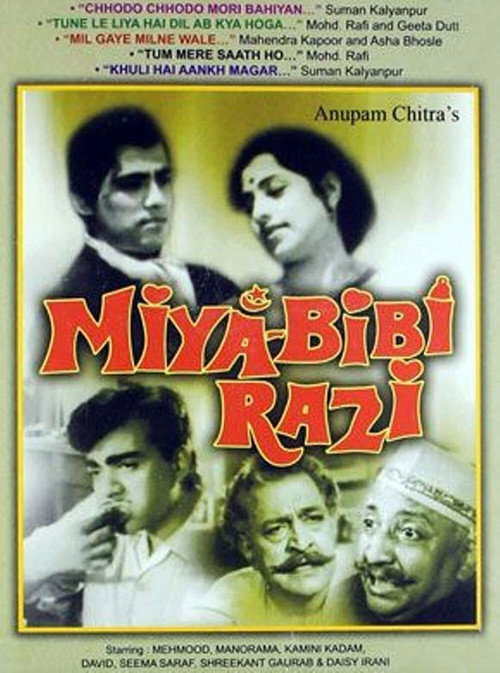
Miya Bibi Razi 1960
Set in the backdrop of mid-20th century India, *Miya Bibi Razi* (1960) weaves a heartfelt tale of societal progress and personal love against the backdrop of dowry—a practice the film boldly challenges.
Frequently Asked Questions
What is *Miya Bibi Razi* (1960) about?
*Miya Bibi Razi* follows Kamla, a passionate schoolteacher who crusades against dowry while navigating her own romantic entanglements with engineer Kumar. Their relationship unfolds against the backdrop of clashing family values—her wealthy father's traditionalism versus Kumar's humble, close-knit household. The film blends romance with a bold critique of societal norms.
Who directed *Miya Bibi Razi*?
Director information is not available.
Who stars in *Miya Bibi Razi*?
The main cast includes the lead actors portraying Kamla, Kumar, Fakirchand, Dhaniram, and Rajni, though specific names are unlisted.
Is *Miya Bibi Razi* (1960) worth watching?
While historical films like *Miya Bibi Razi* may not boast modern cinematic polish, its poignant themes of social justice and heartfelt romance offer timeless appeal. Fans of vintage dramas with layered storytelling will find much to appreciate, especially if they enjoy narratives rooted in real-world struggles.
How long is *Miya Bibi Razi*?
Runtime details are not listed.
About Miya Bibi Razi (1960) — A Vintage Drama of Love, Dowry, and Social Change
Set in the backdrop of mid-20th century India, *Miya Bibi Razi* (1960) weaves a heartfelt tale of societal progress and personal love against the backdrop of dowry—a practice the film boldly challenges. Kamla, a dedicated schoolteacher and fiery activist, dedicates her life to eradicating the toxic norm of dowry, a tradition that pits wealth against dignity. Her path intertwines with Kumar, a skilled engineer hired to upgrade the school's facilities, as their shared ideals spark an unexpected romance. Their relationship unfolds within a tender family dynamic: Kamla's father, Fakirchand, embodies affluence but grapples with the moral weight of tradition, while Kumar's modest household—led by his widowed father, Dhaniram—offers a lens into resilience and simplicity. The film balances warmth with social commentary, capturing the friction between generational values and the promise of change.
At its core, *Miya Bibi Razi* (1960) explores how love and reform can challenge entrenched customs, even in a world divided by class and convention. The story unfolds with a gentle rhythm, blending tender moments between Kamla and Kumar with stark contrasts between their opposing worlds. As Kamla and Kumar's bond deepens, the film asks whether personal courage can rewrite the rules that govern society—and whether their love story could become a mirror for progress itself.