
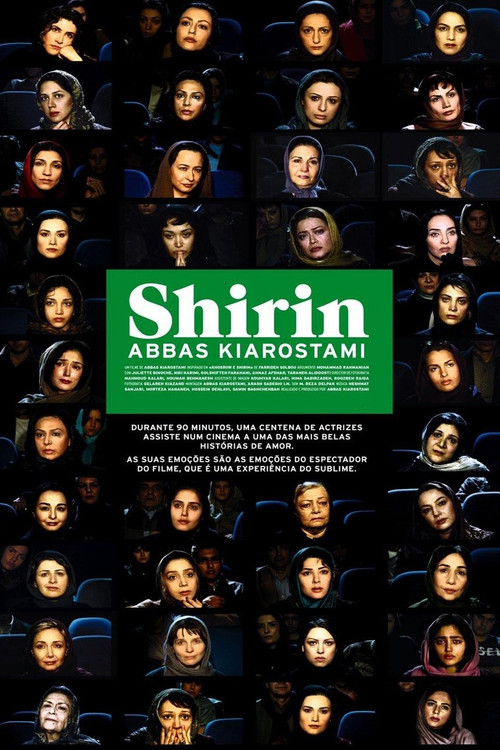
Shirin 2009
"You are the screen, they are the audience."
Abbas Kiarostami's *Shirin (2009)* transforms a 12th-century Persian epic into a mesmerizing visual study of silent emotion.
Director: Abbas Kiarostami
Cast

Taraneh Alidoosti

Golshifteh Farahani

Juliette Binoche

Leila Hatami

Zar Amir Ebrahimi

Hedie Tehrani

Pegah Ahangarani

Baran Kosari

Tannaz Tabatabaei

Ateneh Faghih Nasiri
Frequently Asked Questions
What is Shirin (2009) about?
*Shirin (2009)* follows a room full of legendary actresses as they silently witness a legendary Persian love story. Their unspoken reactions become the film's only narrative, turning the screen into a canvas of fleeting expressions and hidden emotions.
Who directed Shirin?
The film was directed by Abbas Kiarostami, the acclaimed Iranian filmmaker known for his poetic visual storytelling.
Who stars in Shirin?
The cast features Taraneh Alidoosti, Golshifteh Farahani, Juliette Binoche, Leila Hatami, and Zar Amir Ebrahimi among others.
Is Shirin (2009) worth watching?
While *Shirin* isn't for those seeking traditional plot-driven cinema, its visual poetry and emotional depth make it a compelling watch for fans of artistic filmmaking. Its unconventional approach rewards patience with a uniquely immersive experience.
How long is Shirin?
The film runs for 92 minutes.
About Shirin (2009) — A Silent Masterpiece of Emotion and Cinema
Abbas Kiarostami's *Shirin (2009)* transforms a 12th-century Persian epic into a mesmerizing visual study of silent emotion. The film unfolds entirely through the reactions of 114 renowned Iranian actresses and French star Juliette Binoche as they watch an unseen performance of *Khosrow and Shirin*. Without a single line of dialogue, Kiarostami crafts a hypnotic meditation on love, longing, and the power of storytelling, where every glance and tear becomes a narrative in itself. The stark contrast between the invisible stage and the palpable responses of the audience creates an intimate, almost voyeuristic atmosphere.
Stripped of conventional dialogue, *Shirin (2009)* invites viewers to connect with its themes on a deeply human level. The director's signature minimalism highlights the universality of emotional expression, making this drama a unique cinematic experience that lingers long after the credits roll.