
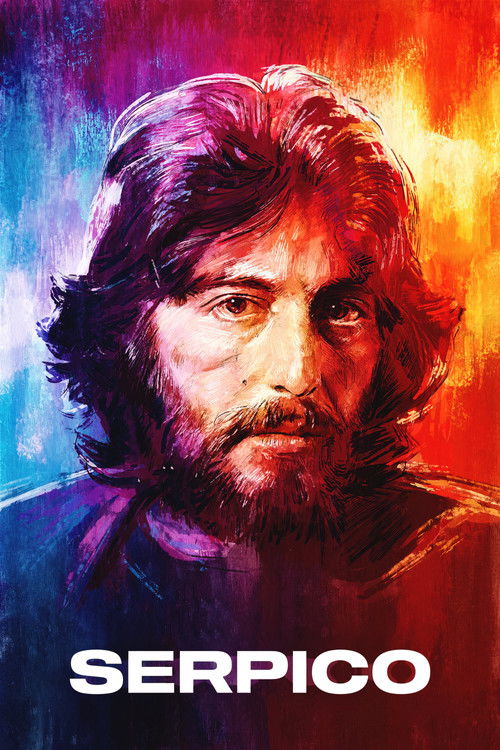
Serpico 1973
"Many of his fellow officers considered him the most dangerous man alive - an honest cop."
Sidney Lumet's gripping crime drama *Serpico (1973)* plunges viewers into the seedy underbelly of New York's police force, where corruption festers in every precinct.
Director: Sidney Lumet
Cast

Al Pacino
Officer Frank Serpico

John Randolph
Sidney Green

Jack Kehoe
Tom Keough

Biff McGuire
Captain McClain

Barbara Eda-Young
Laurie

Cornelia Sharpe
Leslie Lane
Tony Roberts
Bob Blair
John Medici
Pasquale

Allan Rich
D. A. Tauber
Norman Ornellas
Rubello
Frequently Asked Questions
What is Serpico (1973) about?
*Serpico* follows Frank Serpico, a New York City police officer who risks everything to expose widespread corruption in his department. Despite his efforts to bring about change, he faces betrayal from colleagues and mounting danger, turning his fight for justice into a battle for survival. The film captures his unyielding pursuit of honesty in a system designed to shield the guilty.
Who directed Serpico?
Sidney Lumet, the acclaimed director behind gritty social dramas like *Dog Day Afternoon* and *12 Angry Men*, helmed *Serpico*.
Who stars in Serpico?
Al Pacino headlines the cast in his star-making role, with John Randolph, Jack Kehoe, Biff McGuire, and Barbara Eda-Young rounding out the ensemble.
Is Serpico (1973) worth watching?
Absolutely—*Serpico* is a cinematic gem that blends tense drama with real-world stakes. Al Pacino's performance alone makes it essential viewing, while Lumet's sharp direction ensures a compelling, thought-provoking experience. Fans of crime films and character-driven stories will find plenty to admire.
How long is Serpico?
The film runs for 130 minutes.
🎥 Trailer
About Serpico (1973) — Al Pacino's crusade against NYPD corruption revealed
Sidney Lumet's gripping crime drama *Serpico (1973)* plunges viewers into the seedy underbelly of New York's police force, where corruption festers in every precinct. Al Pacino delivers a career-defining performance as Frank Serpico, the idealistic cop who refuses to turn a blind eye to systemic graft. As he exposes the rot within his own ranks, Serpico finds himself increasingly isolated, his loyalty questioned and his safety threatened by those who should protect him. The film masterfully balances tense confrontations with quieter moments of introspection, painting a raw portrait of integrity in a world where dishonesty reigns. With its stark visuals and unflinching realism, *Serpico* transcends its era to ask timeless questions about morality and justice.
The atmosphere crackles with tension as Serpico navigates a labyrinth of deceit, his personal life crumbling under the weight of his crusade. Lumet's direction keeps the narrative relentless, never allowing the audience to escape the moral dilemma at its core—can one man's fight for truth truly make a difference? A standout in the crime-drama canon, *Serpico* remains as relevant today as it was in 1973, a testament to the enduring power of conviction.