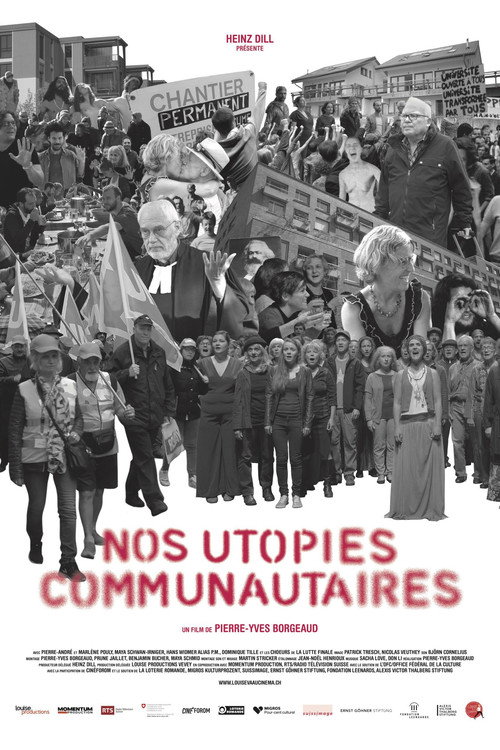
Nos utopies communautaires 2022
Pierre-Yves Borgeaud's *Nos utopies communautaires (2022)* is a reflective documentary that revisits the spirit of 1968, following a generation of former protesters who once dreamed of reshaping society through communal living, squats, and free love.
Director: Pierre-Yves Borgeaud
Frequently Asked Questions
What is *Nos utopies communautaires (2022)* about?
The documentary explores a group of former 1968 activists who once challenged societal norms through communal living and free love. Decades later, they've adopted new communal spaces to redefine aging, focusing on shared values and collective growth in a world that has moved toward individualism.
Who directed *Nos utopies communautaires*?
The film was directed by Pierre-Yves Borgeaud, a filmmaker known for his thoughtful and observational approach to documentary storytelling.
Who stars in *Nos utopies communautaires*?
The documentary features a cast of former activists and community dwellers, whose real-life experiences shape the narrative.
Is *Nos utopies communautaires (2022)* worth watching?
With its thoughtful exploration of aging, community, and the lingering influence of 1968 ideals, the film offers a unique perspective for fans of reflective documentaries. While it lacks a public IMDb rating, its themes and atmosphere make it a compelling watch for those interested in social change and personal evolution.
How long is *Nos utopies communautaires*?
The documentary has a runtime of 100 minutes.
Nos utopies communautaires (2022): A 1968 Legacy Revisited — Full Film Info
Pierre-Yves Borgeaud's *Nos utopies communautaires (2022)* is a reflective documentary that revisits the spirit of 1968, following a generation of former protesters who once dreamed of reshaping society through communal living, squats, and free love. Now in retirement, many have found new purpose in shared spaces where cooperation and collective well-being take center stage.
The film captures their journey with warmth and curiosity, contrasting the idealism of youth with the realities of aging while asking a poignant question: could their once-dismissed utopias hold the keys to a more fulfilling, connected way of living in a world dominated by individualism?